
Yxk Zero1 2-Bay Desktop NAS (Diskless)
4.4Editor score
2.5GbE connectivity for fast transfers
Docker support for advanced users
Compact whisper-quiet design
This guide compares the top diskless NAS enclosures for home and business, evaluating performance, features, and reliability to help you choose the right
Finding the right diskless NAS enclosure is essential for secure, scalable storage without recurring cloud fees. These devices let you host your own private cloud with full control over data and media assets anywhere.
We evaluated ten leading diskless NAS models based on speed, expandability, software ecosystem, and reliability. Our analysis covers home users, creators, and small teams seeking efficient private storage solutions.
Each pick highlights key strengths and ideal use cases to match your workflow needs. Note that availability and pricing may change, so verify details before purchasing to ensure the best fit for your setup.
4.4Editor score

4.6Editor score

4.6Editor score
This side-by-side comparison evaluates ten leading diskless NAS enclosures based on key specifications, connectivity options, software capabilities, and target use cases to help you find the ideal storage solution.




The Synology DS223j offers a reliable entry point into private storage. With a strong user rating it provides secure access automated backups and even surveillance capabilities without complex configuration.
We may earn a commission when you buy through this link, at no additional cost to you.
Its standout features include Synology DSM software which simplifies file sharing and synchronization. The device supports multiple IP cameras enabling home or small business monitoring directly from the NAS unit.
While it lacks advanced expansion options like NVMe caching it remains highly stable for home use. The 2-year warranty and ongoing software updates ensure long-term reliability and support.
This model is ideal for individuals seeking straightforward private storage without cloud subscriptions. Its ease of use and robust security make it a top pick for home media and file backup.
Synology DSM enables easy sharing across devices with granular permissions for family and team collaboration.
Built-in camera support lets you monitor property securely without relying on third-party cloud services.
We may earn a commission when you buy through this link, at no additional cost to you.
The TERRAMASTER D8 Hybrid delivers exceptional capacity combining four SATA and four NVMe slots. Its perfect 5 rating reflects reliable high-speed data access ideal for creators managing large media files.
We may earn a commission when you buy through this link, at no additional cost to you.
Standout features include USB 3.2 Gen2 support delivering up to 10Gbps speeds. The TPM technology optimizes power efficiency ensuring faster wake-up times and safer operations for attached storage.
Since it lacks built-in RAID you must manage redundancy externally or via third-party software. However flexibility in drive maintenance and independent access make it suitable for professional workflows.
Ideal for power users needing massive external storage without NAS complexity. Its speed and capacity make it a powerful DAS solution for editing and archiving tasks.
Supports up to 152TB total capacity allowing endless growth for video and photo libraries.
USB 3.2 Gen2 ensures rapid file movement reducing wait times during creative workflows.
We may earn a commission when you buy through this link, at no additional cost to you.
The Yxk Zero1 offers an affordable gateway to private cloud storage. With 2.5GbE connectivity it ensures fast transfers suitable for streaming and backups without monthly cloud fees.
We may earn a commission when you buy through this link, at no additional cost to you.
Its key strengths include Docker support for tech-savvy users and a quiet lightweight design. The system brings scattered files into one secure hub accessible from any device globally.
Compared to pricier models it lacks extensive app support but covers essential backup and sharing needs well. The one-time investment model helps avoid recurring storage costs indefinitely.
Perfect for budget-conscious home users seeking reliable personal storage. Its balance of speed and simplicity makes it a strong value option in the diskless NAS category.
Eliminates recurring subscription fees by letting you own your storage hardware outright.
Docker support allows custom application deployment for advanced home automation scenarios.
We may earn a commission when you buy through this link, at no additional cost to you.
The UGREEN DXP4800 GT brings pro-grade performance to home and office environments. Powered by AMD Ryzen it handles media processing Docker apps and multi-user workloads with ease.
We may earn a commission when you buy through this link, at no additional cost to you.
Standout capabilities include dual 10GbE networking and built-in Surveillance Center for camera management. UGOS Pro offers a clean interface supporting virtual machines and various self-hosted workflows.
Its high cost is justified by extensive expandability reaching 144TB total. The device prioritizes local privacy with strong encryption and flexible permissions for secure file management.
Ideal for power users and teams needing fast reliable private storage. Its performance and flexibility make it a top-tier choice for demanding NAS tasks.
Dual 10GbE ports and NVMe expansion enable rapid workflows and future-proof growth.
UGOS Pro supports diverse apps including Plex and Home Assistant for complete home control.
We may earn a commission when you buy through this link, at no additional cost to you.
The QNAP TR-004 serves as a robust external storage expansion solution. With hardware RAID support it protects data redundancy without requiring a full NAS operating system.
We may earn a commission when you buy through this link, at no additional cost to you.
Its strengths include easy plug-and-play USB Type-C connectivity and lockable bays for physical security. It integrates well with QNAP NAS systems for expanded volume management.
Limitations include lack of standalone NAS apps and inability to merge pools directly. It works best as a dedicated external drive pool rather than a full network server.
Perfect for users needing extra storage with hardware RAID protection. Its simplicity and compatibility make it a practical add-on for existing QNAP environments.
Built-in RAID support keeps data safe without relying on software-based redundancy.
Lockable bays prevent unauthorized drive removal and protect physical storage integrity.
We may earn a commission when you buy through this link, at no additional cost to you.
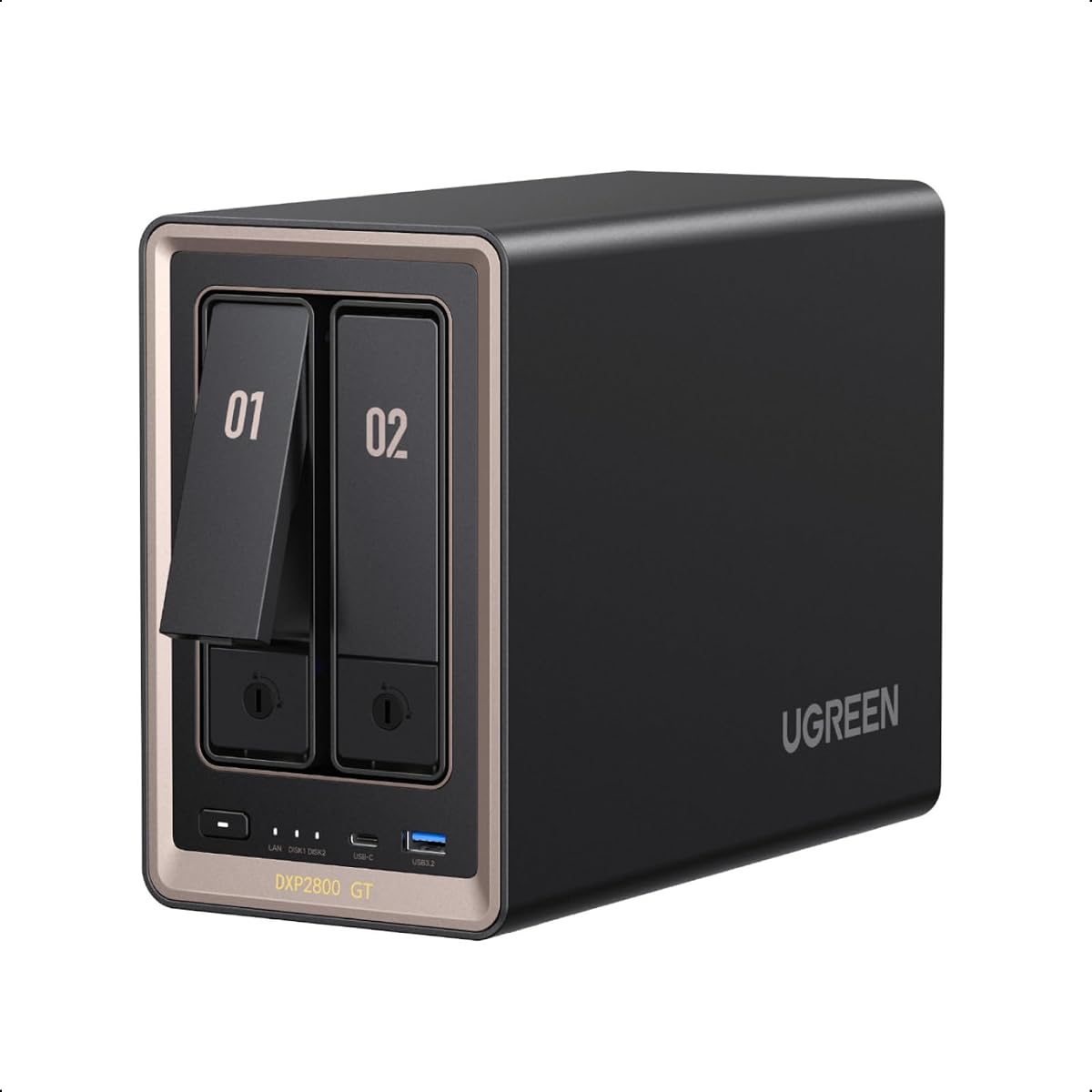
The UGREEN DXP2800 GT is designed for creators requiring fast access and automation. With 10GbE networking it supports large file transfers and media streaming efficiently.
We may earn a commission when you buy through this link, at no additional cost to you.
Key features include UGOS Pro for app expansion and built-in surveillance for home security. Its local privacy tools ensure data remains under user control without cloud dependency.
Trade-offs include default non-ECC RAM which may limit stability for intensive workloads. Manual setup for apps like Plex adds complexity but offers flexibility for custom workflows.
Ideal for freelancers and smart home enthusiasts seeking a fast private cloud. Its performance and privacy features make it a compelling alternative to mainstream NAS brands.
10GbE networking accelerates media editing and backup tasks significantly.
Encryption and local storage options keep personal and business data secure.
We may earn a commission when you buy through this link, at no additional cost to you.
The Synology DS925+ balances performance and expandability for growing needs. Dual 2.5GbE ports deliver fast transfers suitable for photo and media management teams.
We may earn a commission when you buy through this link, at no additional cost to you.
Its strengths lie in Synology DSM offering file and surveillance tools. The 3-year warranty provides assurance for businesses and power users alike.
Compared to lower models it costs more but offers better scalability. It remains ideal for users planning to add drives or upgrade network speeds over time.
Best for small offices or families needing reliable scalable private storage. Its balance of speed and features makes it a versatile NAS investment.
Dual Ethernet ports improve speed and provide backup connectivity if one link fails.
File photo and surveillance tools unify storage and security under one OS.
We may earn a commission when you buy through this link, at no additional cost to you.
The Synology DS425+ is tailored for teams needing secure centralized file access. It supports concurrent users and provides granular permissions to control document and media distribution.
We may earn a commission when you buy through this link, at no additional cost to you.
Key features include audit logs and snapshot tech ensuring data protection and traceability. Surveillance support allows monitoring up to 30 cameras without extra cloud subscriptions.
While expensive it offers enterprise-grade security and support suitable for critical workloads. Its reliability and permission features make it valuable for offices needing strict data control.
Ideal for businesses or families requiring advanced permissions and backup. Its team-focused tools and data safeguards justify the premium price for shared environments.
Audit logs and granular permissions ensure only authorized users access sensitive files.
High-speed streaming allows smooth media sharing across multiple team devices.
We may earn a commission when you buy through this link, at no additional cost to you.
The Synology DX515 expands storage capacity for existing Synology systems. Its plug-and-play setup configures in minutes using DSM tools for unified storage management.
We may earn a commission when you buy through this link, at no additional cost to you.
Key strengths include hot-swap bays allowing drive changes without shutting down the main NAS. This minimizes downtime and simplifies maintenance for growing storage needs.
Limitations include dependency on a compatible Synology NAS unit. It cannot operate independently but serves as a reliable storage tier extension.
Best for Synology owners needing additional capacity. Its integration and ease of use make it a seamless choice for expanding private storage.
Hot-swap capability lets you replace failing drives without interrupting network services.
DSM tools integrate expansion drives into existing pools for easy management.
We may earn a commission when you buy through this link, at no additional cost to you.
The TrueNAS Mini X+ offers enterprise-grade storage features in a compact desktop form. With ZFS filesystem it ensures data integrity through self-healing and error protection.
We may earn a commission when you buy through this link, at no additional cost to you.
Its strengths include massive 32GB ECC RAM and dual 1/10GbE networking for high-performance workloads. VMs and apps like Plex extend functionality for versatile home labs.
Setup complexity and cost limit it to advanced users or small businesses. The hardware support and ZFS reliability provide long-term security against data corruption.
Ideal for users needing maximum data safety and virtualization. Its performance and integrity features make it a powerhouse for demanding storage environments.
ZFS protects against silent corruption and ensures data consistency across drives.
High RAM and VM support allow running multiple services on one server.
We may earn a commission when you buy through this link, at no additional cost to you.
Selecting a diskless NAS enclosure involves balancing storage capacity, network performance, software features, and budget. This guide explores key factors to ensure you find a solution that fits your needs.
The number of drive bays determines how many hard drives you can install. For home users two to four bays often suffice while small teams may need five or more for redundancy and growth.
Ensure the model supports the maximum drive size you plan to use so your storage scales as your needs grow over time.
Network ports define transfer speeds and reliability. Standard 1GbE works for basic use but 2.5GbE or 10GbE ports are essential for streaming 4K media or handling large file transfers.
Dual ports allow link aggregation for faster throughput or failover for continuous operation if one connection drops.
The operating system manages file sharing backups and apps. Synology DSM is known for simplicity while UGOS Pro and TrueNAS offer advanced tools like Docker virtual machines and surveillance.
Check if the software supports your required applications such as media servers cloud sync or home automation before purchasing the hardware.
Look for RAID support and snapshot technology to guard against accidental loss. Some models include built-in surveillance to protect physical assets alongside digital files.
Prioritize units with encryption and granular permissions if privacy is critical for personal or business data.
Consider whether the unit allows adding expansion bays or upgrading RAM later. Some models accept ECC RAM for error correction while others are limited to fixed memory.
Expandable options extend the lifespan of your investment and adapt to future storage or performance requirements.
A longer warranty indicates manufacturer confidence in build quality. Most reliable NAS units come with 2 to 3-year coverage including access to customer support forums.
Verify support availability in your region to ensure timely assistance if hardware issues arise.
NAS units often run 24/7 so power consumption affects energy bills. Look for models with sleep modes or efficient processors to minimize idle power draw.
TPM or similar power management features help balance speed and energy use for eco-friendly operation.
Entry models suit casual users while premium units offer advanced tools for power users. Assess your actual needs before opting for expensive features you may not use.
A well-chosen diskless NAS can save on subscription fees long term providing better total value over years of use.
Begin by installing hard drives according to the user guide. Insert drives into bays and power on the unit to initialize the operating system using the provided setup wizard.
Configure user accounts and permissions to control who can access specific folders. Enable automated backups to external drives or cloud services for redundant data protection.
Maintain your NAS by regularly updating firmware to patch security vulnerabilities. Monitor drive health using built-in tools and replace aging drives before failure occurs.
A diskless NAS enclosure refers to a network storage unit sold without hard drives included. You purchase and install compatible drives separately to customize capacity and performance.
Not every drive is optimized for NAS use. Choose drives designed for 24/7 operation with higher endurance ratings to ensure reliability and longevity in storage servers.
Most core features require no subscription. Some brands offer optional cloud services but basic file sharing backups and remote access work locally without recurring fees.
Remote access is enabled through the manufacturer's mobile app or web portal. Configure port forwarding or use cloud relay services for secure external connections to your NAS.
RAID adds redundancy by mirroring data across drives. While optional it helps protect against drive failure but reduces usable capacity and may cost more in hardware.
Typical NAS units consume 20 to 50 watts depending on drive count and workload. Power-saving modes can reduce consumption significantly when the system is idle.
The Synology DS223j TERRAMASTER D8 Hybrid and UGREEN DXP4800 GT lead our picks for reliability capacity and performance. Each offers distinct strengths suitable for home teams or power users.
Prioritize speed expandability and software features that match your workflow needs. Balancing budget with long-term growth ensures your storage solution remains valuable for years.
Verify current availability and compatibility before purchasing. Checking the latest specifications helps confirm the unit fits your existing network and drive requirements.