
HiFi DAC Audio Sound Card Module PCM5122
4.8Editor score
I2S interface for Pi B+
384KHz sampling rate
LED indicator for status
This guide compares the top DAC for Raspberry Pi models to help you choose the best audio expansion board for your specific project needs.
Finding the right DAC for Raspberry Pi is essential for anyone looking to transform a small computer into a powerful audio streaming device. These expansion boards bypass the weak onboard audio, delivering studio-grade sound quality through high-resolution digital to analog conversion.
We have evaluated ten top-rated audio cards based on build quality, digital performance, and software compatibility. Each product was selected for its ability to integrate seamlessly with popular music players like Volumio and Moode while offering distinct features for different budgets.
Every pick below highlights key specifications and real-world performance traits to help you make an informed decision. Keep in mind that pricing fluctuates based on availability and sales events, so always check the current listings before purchasing your next audio component.
4.8Editor score
4.5Editor score

4.5Editor score
The following comparison table breaks down the critical specifications of all ten selected audio cards. This side-by-side view allows you to quickly identify which model offers the best balance of resolution, interface options, and build quality for your specific Raspberry Pi setup.


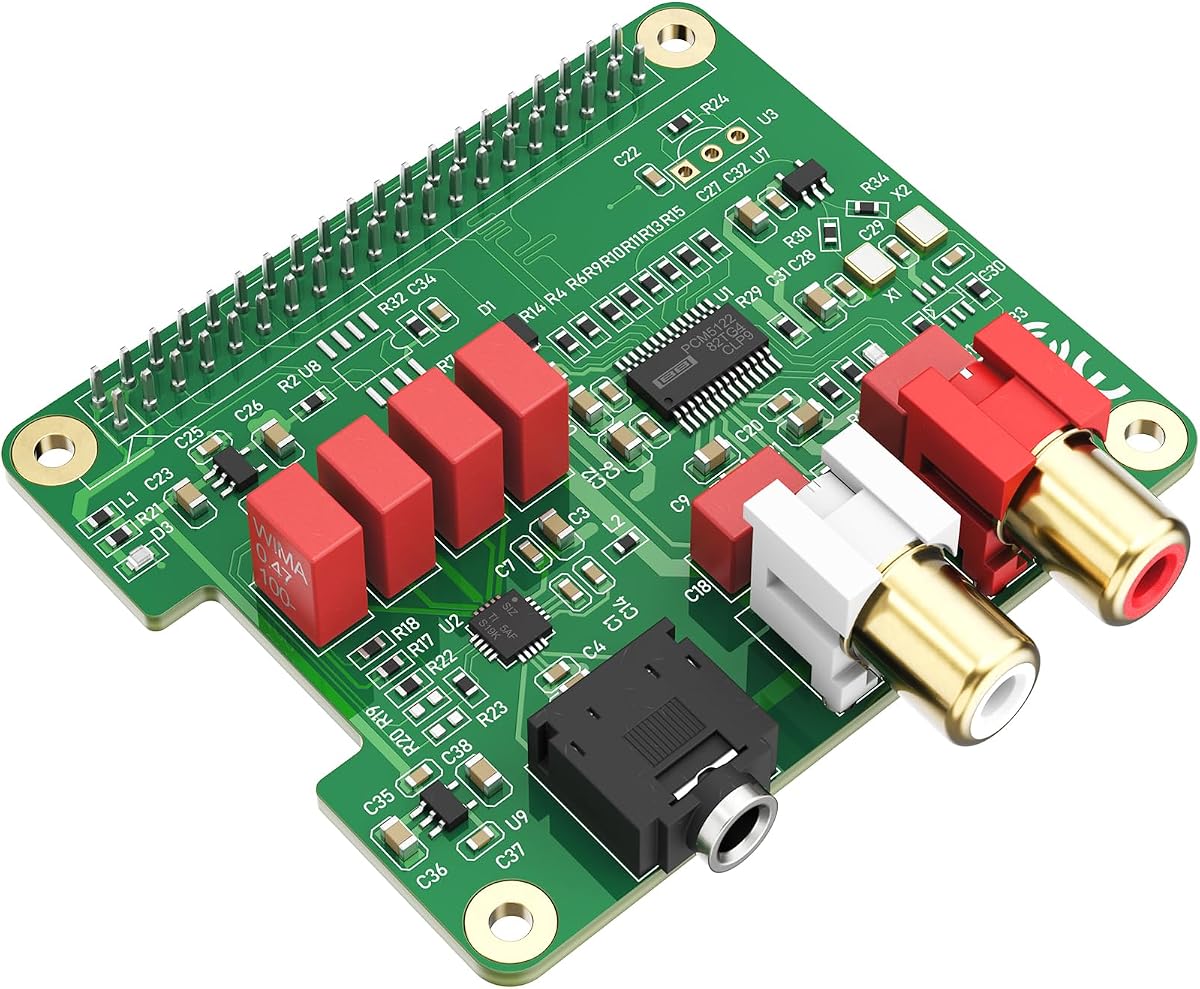
This high-fidelity DAC HAT stands out as the premier choice for audiophiles building a Raspberry Pi streaming system. With a 4.5 star rating, it delivers exceptional clarity through its TI PCM5122 chip and dual independent clock oscillators.
We may earn a commission when you buy through this link, at no additional cost to you.
The board features premium film capacitors and an ultra-low noise power regulation system that ensures pristine signal integrity. You get dedicated RCA and 3.5mm outputs with an onboard headphone amplifier capable of driving high impedance cans.
While it is optimized for the larger boards like Pi 5 and 4, it remains universally compatible with most GPIO headers. The only minor drawback is that it might overhang slightly on the smallest Zero models depending on your case configuration.
Buyers seeking a turnkey solution with zero soldering will find this HAT ideal for their needs. It supports all major music player OS options out of the box and provides detailed technical documentation for further customization.
Independent oscillators eliminate Raspberry Pi jitter for crystal clear audio reproduction across all sampling rates.
Gold-plated RCA and headphone jacks ensure durable and low resistance connections for your audio equipment.
We may earn a commission when you buy through this link, at no additional cost to you.
This module offers the most cost effective entry point into high resolution audio for Raspberry Pi users. Despite its low price, it boasts an impressive 120dB signal to noise ratio which is rare in this budget category.
We may earn a commission when you buy through this link, at no additional cost to you.
The design is straightforward with essential I2S interface connectivity for digital audio data. It includes helpful LED indicators that show power and working status so you can easily troubleshoot connection issues during setup.
The lack of an integrated headphone amp means you will need an external speaker or amplifier to hear the audio. However, for line out connections to powered speakers, this module delivers clean and detailed sound without distortion.
Perfect for DIY enthusiasts on a tight budget, this card transforms basic Pi audio into high fidelity playback. It is compatible with Volumio and XBMC systems making it easy to integrate into existing network audio setups.
Achieves a 120dB dynamic range at a fraction of the cost of premium expansion boards.
Dual LED lights provide immediate visual feedback on power and decoding activity.
We may earn a commission when you buy through this link, at no additional cost to you.
This Pro Hat elevates the Pi audio experience with a flagship ESS ES9038Q2M conversion chip and robust op-amps. It supports extreme formats like DSD512 ensuring that no detail is lost in your high resolution music files.
We may earn a commission when you buy through this link, at no additional cost to you.
The board features a dedicated balanced output stage that allows connection to professional audio equipment using XLR connectors. This design minimizes noise and interference making it suitable for long cable runs in demanding studio environments.
Independent clock oscillators ensure perfect sample timing which is critical for accurate sound reproduction. The use of three Texas Instruments op-amps provides ample power to drive high impedance headphones without any loss of dynamics.
Advanced users who demand the absolute highest fidelity should choose this premium option. It is fully compatible with Pi 5 and earlier models and comes with extensive documentation to help you unlock its full potential.
Dedicated XLR outputs reduce interference and improve signal quality for professional monitoring.
Full compatibility with DSD512 allows playback of the highest quality audio files available.
We may earn a commission when you buy through this link, at no additional cost to you.
The Digi One Hat is a specialized digital sound card designed to provide a clean and isolated S/PDIF output. It is perfect for users who already own a high-end external DAC and want to improve the source signal quality.
We may earn a commission when you buy through this link, at no additional cost to you.
What sets this board apart is its use of industrial grade isolators that provide complete galvanic isolation from the Raspberry Pi. This eliminates ground loops and electrical noise that can otherwise degrade your audio signal.
It supports both optical Toslink and electrical RCA connections ensuring compatibility with a wide range of audio systems. The I2S master mode design with dual oscillators ensures accurate clocking for high sample rate audio up to 192kHz.
If you need a pristine digital output that does not introduce noise this is the ideal choice. It supports all popular Pi music player systems and works seamlessly with standard OS distributions.
Galvanic isolation separates digital signals from Pi power to prevent noise injection.
Designed for entire Raspberry Pi series without overhang or compatibility issues.
We may earn a commission when you buy through this link, at no additional cost to you.
This PCM5122 module offers a reliable and compact solution for adding high resolution audio to your Pi project. It leverages the I2S interface for clean digital audio transfer and supports a wide sampling rate range.
We may earn a commission when you buy through this link, at no additional cost to you.
The board includes two distinct LED indicators for power and working status which helps verify connectivity quickly. It is designed to work with popular systems like Volumio and XBMC for easy configuration.
While it lacks advanced features like built-in amplification it excels in delivering a clean digital signal to external gear. The compact size makes it easy to fit inside tight enclosure cases without adding bulk.
Ideal for simple music streaming setups this card provides the essential audio conversion needed for high quality sound. It supports 16 to 32 bit resolution ensuring your music is decoded with high precision.
Uses I2S for direct digital data transfer to improve audio signal integrity.
LED indicators confirm operational status and power connection at a glance.
We may earn a commission when you buy through this link, at no additional cost to you.
The RASPIAUDIO DAC Hat is a versatile audio card designed to work across almost all Pi models from Zero to Pi 5. It features an onboard EEPROM that simplifies setup allowing for a plug and play experience.
We may earn a commission when you buy through this link, at no additional cost to you.
Audio performance is highlighted by a 32-bit 384kHz DAC that delivers a crisp 112dB signal to noise ratio. This ensures that your music sounds clear and detailed compared to the onboard analog audio.
You get both RCA and 3.5mm jacks for flexible connection to speakers or headphones. The PCB is color coded and designed to be aesthetically pleasing if you plan to leave it exposed in a case.
This hat is a solid choice for general music listening and media center projects. Its compatibility with modern boards and simple installation process makes it a great option for beginners and hobbyists alike.
Compatible with Pi 5, 4, Zero v2 and earlier versions for maximum flexibility.
Onboard EEPROM enables plug and play functionality without driver installation.
We may earn a commission when you buy through this link, at no additional cost to you.
This DAC is specifically designed to complement the Argon ONE V3 case for the Raspberry Pi 5. It utilizes a TI PCM5122 audio codec to provide a clean digital to analog conversion for your music.
We may earn a commission when you buy through this link, at no additional cost to you.
The key feature of this board is the included Ground Loop Isolator which actively prevents electrical noise and hum from entering your audio chain. This results in a cleaner listening experience especially with sensitive equipment.
Installation is straightforward and the audio is routed through a 3.5mm port for easy connection to your speakers. It is marketed as a premium companion for audiophiles and professionals looking to upgrade their Pi setup.
If you are running a Pi 5 inside an Argon case this is a perfect pairing for audio. The isolator ensures that your audio signal remains pure and free from any interference generated by the computer.
Ground Loop Isolator prevents hum and noise transmission in your audio signal.
Designed for plug and play setup with minimal configuration required.
We may earn a commission when you buy through this link, at no additional cost to you.
This high-performance DAC features a powerful Digital Signal Processor that allows for advanced audio manipulation and control. It supports up to 192kHz output and can run complex DSP tasks like room equalisation.
We may earn a commission when you buy through this link, at no additional cost to you.
The DSP capabilities enable you to upsample downsample and mix audio sources directly on the board. You can change parameters on the fly giving you total control over your audio processing chain.
An onboard EEPROM allows the board to boot and run even without the Pi attached which is unique for a HAT. However it requires a specific Universal CaseIII enclosure which adds to the total system cost.
For advanced audio projects like home theater systems this DAC offers unmatched flexibility. It is a powerful tool for anyone needing custom audio shaping or standalone DAC functionality.
Runs up to 6144 instructions per sample for complex audio processing tasks.
Built-in support for room equalisation helps optimize sound for your specific space.
We may earn a commission when you buy through this link, at no additional cost to you.
The HiFiBerry Digi+ provides a dedicated digital audio interface that connects to your external amplifier or DAC. It supports high resolution formats up to 192kHz/24bit ensuring a pristine digital audio stream.
We may earn a commission when you buy through this link, at no additional cost to you.
You get both optical Toslink and electrical coaxial connections which gives you flexibility in wiring your setup. The bit-perfect output means the audio data is not modified or downgraded in any way.
This card is specifically designed for older Pi models like Pi 2 Model B and B+ which means it may not fit newer 40 pin headers. However it remains a reliable choice for those maintaining legacy systems.
If you need a solid digital output solution for older hardware this card is excellent. It is easy to configure and works with standard Linux audio drivers for seamless operation.
Ensures audio data remains unmodified from source to output device.
Supports both Toslink and Coaxial connections for broad amplifier compatibility.
We may earn a commission when you buy through this link, at no additional cost to you.
This module is one of the most affordable ways to add lossless digital audio decoding to your projects. It uses the PCM5102A DAC which provides a significant upgrade over the built-in analog audio of any computer.
We may earn a commission when you buy through this link, at no additional cost to you.
The module features a stereo jack that is already soldered to the board simplifying the connection to your speakers. It connects via the I2S interface for reliable and clean audio data transfer.
While it is a basic module without extra shielding or clocks it delivers surprisingly good sound for its size. It works with both Raspberry Pi and Arduino making it a versatile choice for embedded audio projects.
Best for hobbyists looking for a cheap upgrade this module is easy to integrate. It requires some wiring but the price point makes it an easy recommendation for experimentation.
Provides high quality audio conversion at a super affordable price point.
Stereo jack comes pre-soldered to reduce setup time for users.
We may earn a commission when you buy through this link, at no additional cost to you.
Selecting the right DAC involves evaluating compatibility performance and specific features needed for your listening environment. This guide explains the key factors to consider before purchasing.
Ensure the board fits your Raspberry Pi model. Most modern HATs use 40-pin headers while older cards are for Pi 2. Check for physical overhang on smaller boards like the Zero.
Choose a board that fits your specific Pi model to avoid installation issues or short circuits.
The internal DAC chip determines sound quality. Look for models using TI PCM5122 or ESS ES9038Q2M chips for high fidelity performance.
Prioritize boards with reputable DAC chips to ensure high resolution audio processing.
Decide between analog outputs like RCA or 3.5mm jacks versus digital outputs like S/PDIF. Analog outputs connect directly to speakers while digital outputs require an external DAC.
Select the output type that matches your existing audio equipment setup.
Independent clock oscillators reduce jitter which improves timing accuracy in the audio signal. Boards with dual oscillators provide a significant upgrade over those using the Pi clock.
Opt for boards with independent clock sources for better audio clarity and timing.
Check if the board is tested with music players like Volumio or Moode. Good support means drivers are built-in and configuration is straightforward.
Choose boards with broad software compatibility to minimize setup time and technical issues.
Look for boards with film capacitors and low noise power regulators. These components protect the signal from interference and ensure stable operation.
Focus on build quality features like high-grade capacitors to ensure long-term reliability.
If you plan to connect headphones directly ensure the DAC includes a headphone amplifier. Some cards require external amps for high impedance cans.
Ensure the board has a built-in headphone amp if you need to drive headphones directly.
Advanced users might need features like DSP or balanced outputs. Cards like the DAC+ DSP offer room equalisation and flexible audio processing capabilities.
Consider advanced features if you need specialized audio processing capabilities for your project.
First install your DAC onto the GPIO header ensuring the pins align correctly. Avoid forcing the board to prevent bending the connectors. Then boot your Pi and enable the I2S interface in the system config file if required.
Next configure your music player software to use the DAC as the default audio device. Most systems like Volumio or Moode detect HATs automatically. You may need to select the correct output device in the audio settings menu.
To ensure longevity keep the board away from dust and excessive moisture. If you use headphones connect them via the proper 3.5mm port. Regularly check your software updates to maintain driver compatibility with new OS versions.
Most DAC HATs draw power directly from the GPIO header so no separate supply is needed. However high power output boards may benefit from a dedicated 5V supply to ensure stability. Always check the specific power requirements of your model.
Many modern HATs use 40-pin headers which are not compatible with the 26-pin headers of older Pi 2 models. Look for adapters or cards specifically designed for legacy Pi boards to ensure proper connectivity.
Analog outputs provide a signal ready for speakers or amplifiers. Digital outputs like Toslink send raw digital data to an external DAC which then converts it to analog. Use digital outputs if you have high-end external amplifiers.
Yes most DAC HATs are compatible with Raspberry Pi OS. You may need to enable audio overlays in the config file. Using specialized music OS software often provides better out of box support for audio cards.
You can check status by playing a high resolution audio file. Many DAC boards have LED indicators for power and activity. Use software tools to verify sample rates are changing as you play different tracks.
Yes a GPIO-connected DAC is generally superior to USB adapters because it uses a more stable digital connection and reduces noise. HATs often provide better shielding and dedicated audio processing for high fidelity playback.
Generally a single GPIO I2S device is supported at a time. You would need a USB DAC alongside a HAT if you want multiple outputs. Ensure your software supports routing audio to multiple devices simultaneously.
High quality DACs support formats like FLAC ALAC and DSD. The PCM5122 chip supports 32-bit 384kHz PCM and many cards support DSD over PCM. Check the DAC specifications to confirm your preferred file formats are supported.
We have reviewed the top DAC options from affordable modules to high-end HATs. The HiFi DAC HAT remains our top pick for its balance of performance and ease of use across modern Pi models.
When prioritizing features focus on clock stability and output options that match your speakers. Budget models like the HiFi DAC module still deliver excellent value for casual listening.
Always check current pricing and compatibility before buying. Prices and availability can change so verify your selection fits your specific Pi version and case requirements before placing an order.