
200AH Lead Acid Battery Desulfator
4.4Editor score
Auto pulse desulfation technology
Supports 12V to 48V systems
Compact design for easy installation
Discover the top battery restorer and desulfator solutions for 2026. Compare additives and pulse devices to extend lead-acid battery life and performance.
Finding the right battery restorer and desulfator can save you significant money on replacements. These tools target sulfation, a common cause of lead-acid battery failure. Whether you manage a fleet or maintain a single vehicle, choosing the right solution matters.
We evaluated ten leading products based on user feedback, technical specifications, and reported success rates. Our list includes both liquid additives and electronic pulse devices. Each option addresses sulfation differently, so understanding your battery type is key to selecting the best fit.
Every review highlights core features, compatibility, and real-world performance expectations. We also include a detailed buying guide to help you narrow down choices. Prices and availability change frequently, so check current listings before purchasing to ensure you get the best value.
4.4Editor score

3.8Editor score

4.1Editor score
This comparison table outlines the key specifications and capabilities of each product. Use it to quickly identify voltage ranges, treatment capacity, and compatibility with different battery chemistries.




This product is a gallon-sized liquid solution designed to extend the life of lead-acid batteries by dissolving sulfate buildup. Users report measurable improvements after a week of regular charging. It targets batteries that still accept a charge but struggle to hold it.
We may earn a commission when you buy through this link, at no additional cost to you.
The formula penetrates cells to free plates for better energy delivery. It is non-toxic and made in the USA, offering peace of mind for handling. One bottle treats multiple batteries, making it efficient for golf carts or RVs.
While effective, it requires patience as results show over several days of charging. It will not revive completely dead or frozen batteries. Understanding these limitations ensures you apply it to serviceable units.
Buy this if you manage multiple batteries or need a cost-effective chemical treatment. It is ideal for maintenance rather than emergency rescue of ruined cells.
Treating three to six batteries with one gallon reduces the cost per unit significantly compared to buying individual smaller bottles.
The non-toxic formula allows users to handle it without protective gear, though standard safety practices for battery areas still apply.
We may earn a commission when you buy through this link, at no additional cost to you.
This device uses high-frequency pulses to dissolve lead sulfate on battery plates. It supports systems from 12V up to 72V, covering cars, solar, and golf carts. Users appreciate its versatility across different battery chemistries like AGM and Gel.
We may earn a commission when you buy through this link, at no additional cost to you.
Safety features like low-voltage cutoffs prevent damage during operation. The aluminum shell aids heat dissipation. It connects in parallel with a charger to condition the battery while maintaining charge levels effectively.
Results vary based on sulfation severity, often taking weeks to manifest. It is not a magic fix for physically damaged cells. Consistent use over time yields the best restoration outcomes.
Choose this if you need a universal electronic solution for various battery banks. It is suitable for hobbyists and professionals managing diverse equipment.
The ability to handle systems up to 72V makes it compatible with industrial equipment and large solar arrays beyond standard vehicles.
Smart cutoffs and fuses protect both the device and the battery from electrical faults during the desulfation process.
We may earn a commission when you buy through this link, at no additional cost to you.
This compact device delivers automatic pulse regeneration to lead-acid batteries. It fits for voltage ranges from 12V to 48V, common in cars and RVs. Users value its simplicity and low price point for basic maintenance needs.
We may earn a commission when you buy through this link, at no additional cost to you.
Connection is straightforward with automatic voltage detection. It works in parallel with a charger to keep the battery active while preventing crystal buildup. The small form factor makes it easy to install in tight battery compartments.
While affordable, it lacks advanced diagnostics found in pricier units. It is best suited for routine care of healthy but aging batteries. Expect gradual improvements over a few weeks.
Select this if you need an economical way to maintain standard lead-acid batteries. It is great for budget-conscious owners looking to extend battery life without heavy investment.
The automatic voltage recognition means no manual dial adjustments are needed when connecting to different battery voltages.
At a lower price point than many competitors, it offers an accessible entry into electronic desulfation technology.
We may earn a commission when you buy through this link, at no additional cost to you.
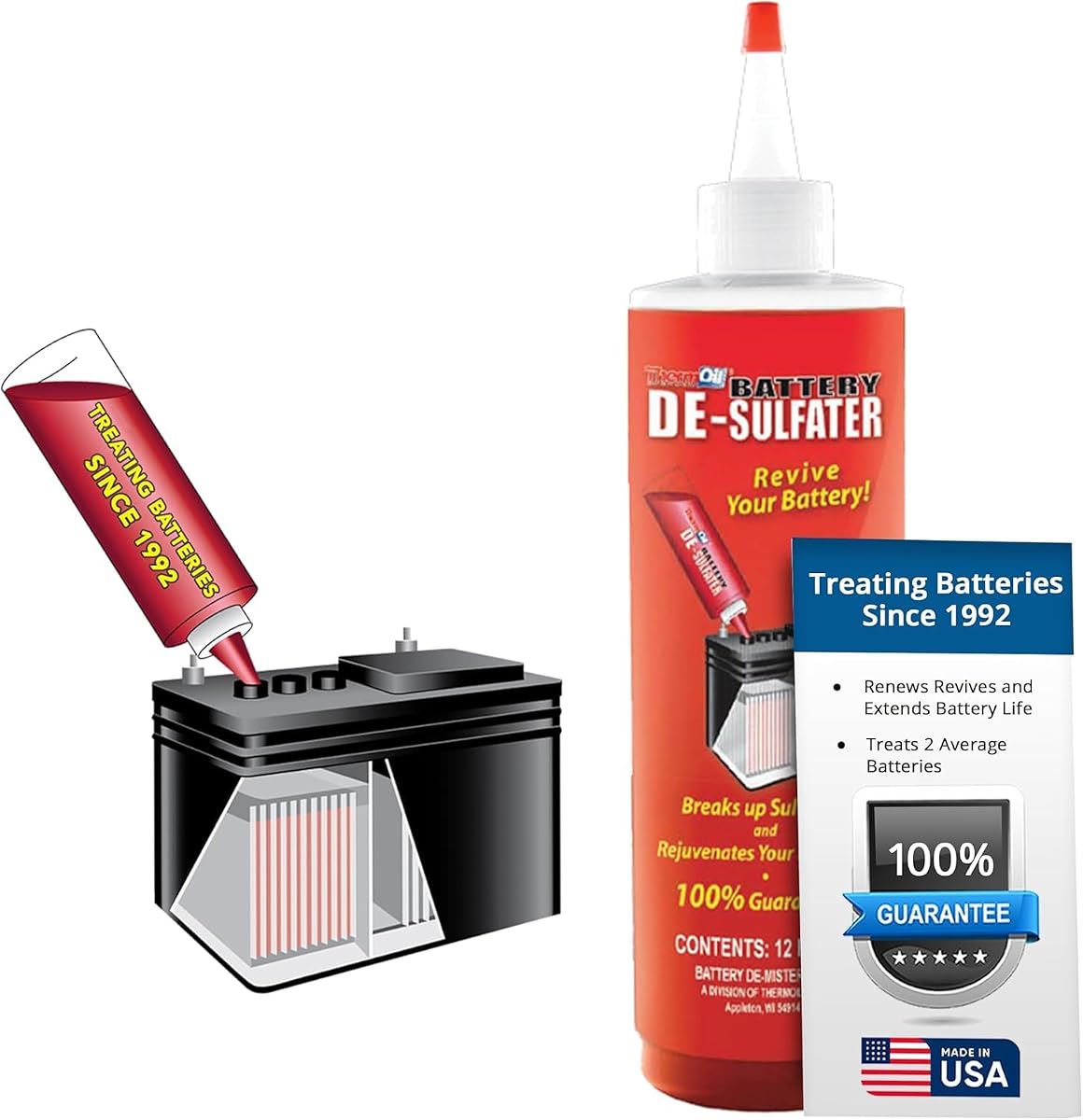
This solution targets sulfation with a non-acid formula that avoids Epsom salts. It aims to reduce resistance and internal heating. Users note its long history of use since 1992, suggesting reliability.
We may earn a commission when you buy through this link, at no additional cost to you.
Adding it as an electrolyte additive requires no draining. It works gradually to break down corrosion on plates. The manufacturer offers a guarantee, aiming to instill confidence in results.
The price is higher than generic options, which might deter budget buyers. It requires consistent charging to activate the formula. Patience is key for realizing benefits.
Choose this if you trust established brands with proven track records. It suits users who prefer chemical additives over electronic tools for maintenance.
A history dating back to 1992 suggests the formula has been refined over decades of practical application.
Reducing internal resistance helps the battery deliver power more efficiently, potentially extending range or runtime.
We may earn a commission when you buy through this link, at no additional cost to you.
This additive is designed to restore chemical balance within lead-acid batteries. It helps remove sulfation buildup that limits charge capacity. Users report it works across a wide range of vehicles and machinery.
We may earn a commission when you buy through this link, at no additional cost to you.
It is formulated to be safe for internal components. Adding it helps prolong life and improve performance. It acts as both a refiller and rejuvenator.
Success depends on the battery still accepting a charge. It is not a fix for completely dead cells. Consistent use after adding the product is necessary for best results.
Buy this if you need a simple liquid treatment for various lead-acid applications. It is suitable for general maintenance to prevent future issues.
The formulation is gentle on internal parts, reducing risk of damage during the restoration process.
It works well on everything from golf carts to ATVs, making it a versatile choice for multi-vehicle owners.
We may earn a commission when you buy through this link, at no additional cost to you.
This 12oz bottle offers a convenient size for treating individual batteries. It follows the same non-hazardous formula as larger variants. Users appreciate the ease of adding it as an electrolyte additive.
We may earn a commission when you buy through this link, at no additional cost to you.
It helps break down corrosion on plates and reduces internal resistance. The smaller packaging is easy to store in a garage or toolbox. It is effective for occasional maintenance tasks.
For multiple batteries, you would need several bottles, increasing total cost. It requires standard charging cycles to work. Best for single battery owners.
Choose this if you maintain just one or two batteries. It is a cost-effective way to try the brand without committing to a gallon.
The small 12oz size fits easily in most storage cabinets, making it accessible for quick use.
Perfect for users who need to treat a single vehicle or boat battery without excess liquid.
We may earn a commission when you buy through this link, at no additional cost to you.
This solution is formulated specifically for maintaining golf cart battery banks. It treats three to six batteries with a single gallon. Users note it helps avoid premature replacements by restoring capacity.
We may earn a commission when you buy through this link, at no additional cost to you.
The product is made in the USA and non-toxic. It works by breaking down harmful lead sulfate buildup on plates. Regular charging cycles are needed after application.
It does not work on AGM or gel types. Only use on serviceable batteries that still take a charge. This distinction is crucial for planning your maintenance schedule.
Buy this if you manage golf carts or similar fleets. It is a practical choice for reducing long-term replacement costs.
Treating multiple batteries at once ensures consistent performance across your entire cart fleet.
USA manufacturing often implies stricter quality control standards for chemical formulations.
We may earn a commission when you buy through this link, at no additional cost to you.
This device is capable of handling larger batteries up to 400AH. It uses high-frequency pulses to prevent sulfate from sticking to electrodes. Users report it extends life by keeping the electrode state healthy.
We may earn a commission when you buy through this link, at no additional cost to you.
The auto-setting feature identifies voltage automatically upon connection. It works alongside chargers to maintain performance. The process is gradual, often taking weeks to show improvement.
Ensure the battery is above 11.5V before connecting. If it is lower, charge it first. This prevents unnecessary failure to activate the device.
Select this if you have larger capacity deep cycle batteries. It is robust for RVs or marine setups needing higher amp-hour support.
The 400AH limit allows it to support large marine or industrial batteries that standard units cannot.
Automatic recognition removes the guesswork from connecting the device to different battery configurations.
We may earn a commission when you buy through this link, at no additional cost to you.
This liquid solution aims to clean deposits and restore charging capacity quickly. Users claim improvements within 1-2 hours of recharge. It is versatile for boats and trucks.
We may earn a commission when you buy through this link, at no additional cost to you.
You do not need to empty existing liquid before adding. This simplifies the process significantly. It allows the battery to discharge normally after treatment.
Do not use on frozen or physically damaged cells. Always test the battery voltage before adding to ensure it will accept a charge.
Choose this if you need faster results compared to other chemicals. It suits those wanting a quick refresh for aging batteries.
The quick 1-2 hour recharge window offers a faster turnaround than other chemical options.
Adding without emptying reduces steps, making it accessible for DIY maintenance.
We may earn a commission when you buy through this link, at no additional cost to you.
This device uses automatic pulse technology to recondition lead-acid batteries over time. It works with deep cycle types like marine and RV. Users value its simplicity and ability to dissolve crystals.
We may earn a commission when you buy through this link, at no additional cost to you.
Installation involves connecting terminals for continuous maintenance. It helps extend life by addressing sulfation. While basic, it serves its purpose well for maintenance.
It needs to stay connected to be effective. Results are gradual and depend on usage patterns. It is not a heavy-duty industrial tool.
Buy this for simple battery maintenance on a budget. It is good for keeping batteries healthy during long storage periods.
Designed for long-term connection, it helps prevent issues before they arise rather than just fixing them.
The simple connection process means no complex settings to adjust, making it beginner-friendly.
We may earn a commission when you buy through this link, at no additional cost to you.
Selecting the right solution depends on your battery type and maintenance goals. Use this guide to understand the key factors before purchasing.
Check if your battery is flooded, AGM, or gel. Some liquid additives only work on flooded types, while electronic devices usually support all. Always verify compatibility to avoid damage.
Choose a product explicitly compatible with your battery chemistry.
Ensure the desulfator supports your system voltage. Common vehicles use 12V, but golf carts and solar often need higher ranges. A mismatch can cause failure or no results.
Select a device covering your specific voltage needs.
For fleets, a gallon additive might be more cost-effective than multiple small bottles. Check how many batteries one unit treats. This matters for long-term budgeting.
Calculate volume needs based on the number of batteries you maintain.
Decide between chemical and electronic solutions. Chemicals require adding to cells and waiting days. Electronics run in parallel and take weeks. Your preference affects ease of use.
Pick the method that fits your maintenance style.
Look for devices with safety features like cutoffs and fuses. This protects the device and battery during operation. Chemicals should be non-toxic for safe handling.
Prioritize safety to prevent accidents or damage.
Chemicals may show results faster in days, while electronics take weeks. Consider how soon you need the battery to function. Patience is often required for electronic units.
Factor in expected wait times before purchase.
If using outdoors, choose a rugged device. Aluminum shells and heat dissipation matter for electronics. Chemical bottles should be sturdy to avoid leaks.
Ensure the build quality matches your environment.
Some products offer guarantees if performance fails. This reduces risk for electronic units. Chemicals often have limited warranties due to usage variables.
Check for guarantees to support your purchase decision.
For liquid additives, open cell caps and add the specified amount per cell. Do not drain the existing electrolyte unless instructed. Seal caps securely after application.
For electronic desulfators, connect terminals matching polarity. Place the device near the battery for heat dissipation. Let it run while the battery is on charge or standby.
Monitor the battery over weeks for improved capacity. Recharge fully after applying chemicals. Keep connections tight to ensure proper operation.
Desulfators can only help batteries that still accept a charge. If a battery is completely dead or frozen, it likely needs replacement. Check voltage before using these products.
Most liquid additives do not work on AGM batteries. Check the label carefully. Electronic desulfators often support AGM types instead.
Use electronic units continuously for maintenance. Apply liquids once or twice a year depending on usage. Follow the manufacturer schedule for best results.
No, you can treat batteries in place. Ensure the vehicle is off. For liquids, open caps carefully. For electronics, just connect terminals.
Yes, sulfation is reversible if caught early. These products break down sulfate crystals. If buildup is too severe, the battery may be ruined.
Proper pulse devices do not harm healthy batteries. They maintain performance and prevent issues. Ensure the unit is certified for safe use.
We reviewed ten top solutions for restoring and desulfating lead-acid batteries. The electronic options offer automation, while additives provide low-cost treatments.
Prioritize compatibility with your battery type and voltage. Consider your budget and maintenance preferences when selecting a tool.
Prices and stock change often. Always check current listings to find the best deals before buying.