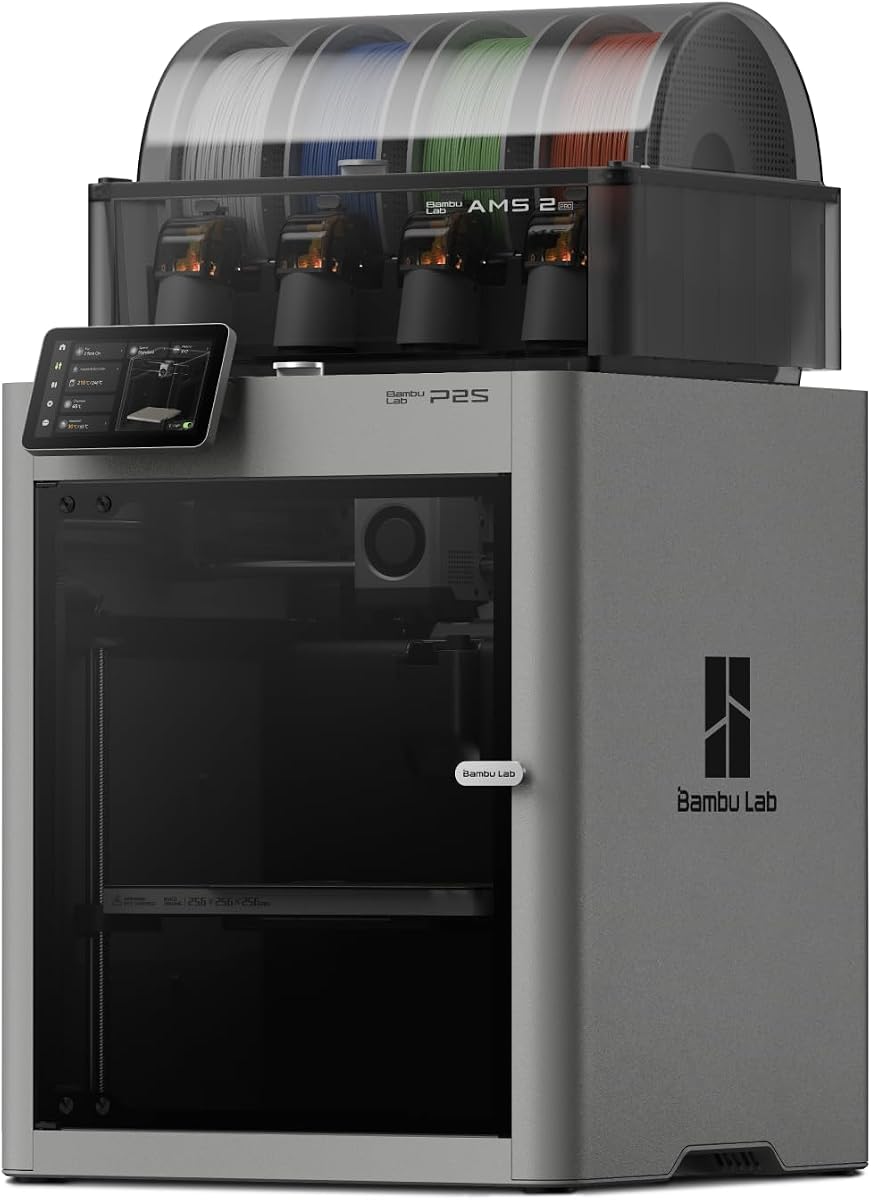
Bambu Lab P2S Combo, P2S 3D Printer & AMS 2 Pro, Multi-Color 3D Printing
4.7Editor score
High-speed precision printing
Ready to print in minutes
Effortless multi-color printing
This guide compares the top 10 3D printers for engineering prototypes, evaluating speed, materials, build volume, and multi-material capabilities for profession
Engineering prototypes demand precision, reliability, and material versatility. Choosing the right 3D printer ensures your designs translate accurately into functional parts for testing and validation in real-world scenarios.
We evaluated leading models based on build volume, printing speed, material compatibility, and ease of use. Each product was selected for its ability to handle complex geometries and industrial-grade filaments effectively.
Each pick highlights key strengths and potential trade-offs to help you decide. Prices and availability change frequently, so verify current details before purchasing to ensure you get the best value for your needs.
4.7Editor score

3.5Editor score

4.4Editor score
This comparison table provides a side-by-side overview of the top 10 models, highlighting key specifications like build volume, speed, and material support to help you make an informed decision quickly.





The Original Prusa XL stands out as a top choice for engineers needing large-format, multi-material prototypes. With a 14.17-inch cube build volume and dual toolhead system, it handles complex prints efficiently.
We may earn a commission when you buy through this link, at no additional cost to you.
Its segmented heated bed and CoreXY motion ensure stability and accuracy across large parts. Intelligent tool switching minimizes waste while maintaining high-quality transitions between materials for professional results.
While it requires some assembly and investment, the reliability and support from Prusa Research make it worthwhile. It excels for functional prototypes requiring soluble supports or multiple material properties.
Engineers and studios seeking industrial-grade performance should consider the Prusa XL. It balances size, precision, and material versatility for demanding prototyping needs.
The dual tool system enables seamless switching between materials for complex prints and soluble support structures without manual intervention.
Built for engineering teams, it offers reliable industrial-grade performance at scale with reduced warping across the entire platform.
We may earn a commission when you buy through this link, at no additional cost to you.
The Bambu Lab P2S Combo offers exceptional speed and ease of use for rapid prototyping. It prints up to 600 mm/s while maintaining accuracy with active flowrate compensation.
We may earn a commission when you buy through this link, at no additional cost to you.
Setup takes only 15 minutes, and the AMS 2 Pro enables multi-color prints with built-in filament drying. Adaptive airflow ensures crisp overhangs and consistent results.
It may lack full enclosure for high-temp materials without mods, but it's great for PLA, PETG, and TPU. Beginners and pros alike benefit from its smart features.
For budget-conscious users needing fast, reliable prints, the P2S Combo is ideal. It simplifies workflows and delivers professional-grade results efficiently.
Set up in 15 minutes and start printing with AI failure detection and automatic calibration for effortless professional-grade results.
The AMS 2 Pro features built-in filament drying at 65°C to keep spools ready for flawless prints.
We may earn a commission when you buy through this link, at no additional cost to you.
The QIDI Max4 Combo excels with an ultra-large build volume, enabling single-piece prints of industrial parts and complex molds. Its closed-loop motors and 65°C chamber ensure precision and stability.
We may earn a commission when you buy through this link, at no additional cost to you.
High-flow hotend supports abrasive materials like carbon fiber nylon. AI monitoring detects failures instantly. While the Polar Cooler is separate, it's a solid choice for engineers needing large, high-temp prints.
It offers expandable multi-color via QIDI BOX. The interface is user-friendly for both professionals and enthusiasts requiring large-format capabilities.
For projects demanding size and material versatility, the Max4 Combo is unmatched. It reduces splitting needs and ensures consistent quality across large prototypes.
The 390x390x340mm printing area enables printing large industrial parts without splitting.
65C active heated chamber and hardened steel nozzle support high-temperature materials like ABS-CF and PC.
We may earn a commission when you buy through this link, at no additional cost to you.
The Snapmaker U1 offers unique true multi-material printing with four independent toolheads and a 5-second changer. It reduces waste by 5x compared to traditional purging systems.
We may earn a commission when you buy through this link, at no additional cost to you.
Combine rigid, flexible, and soluble supports in one print. Auto calibration ensures accuracy. It's ideal for intricate prototypes requiring diverse material properties.
The build volume is smaller than others, but flexibility is unparalleled. Beginners and pros can use its touchscreen and app for remote control.
Choose this if multi-material complexity is key. It simplifies creating parts with varying hardness or support types without manual swaps.
Four independent toolheads reduce filament waste by up to 5X and enable up to 5X faster multi-color printing.
Combine rigid and flexible materials and water-soluble supports in a single print for greater design flexibility.
We may earn a commission when you buy through this link, at no additional cost to you.
The Bambu Lab A1 brings professional speed and precision to a compact, easy-to-use package. It accelerates at 10,000 mm/s² while maintaining exceptional accuracy and detail.
We may earn a commission when you buy through this link, at no additional cost to you.
Full-auto calibration eliminates hassles, and active flow compensation ensures smooth prints. Add AMS lite for multi-color options. It's ideal for beginners or small prototyping labs.
Lack of enclosure limits high-temp materials, but it's perfect for PLA and PETG. Its quiet operation fits shared spaces.
If you need a quick-start printer with smart features, the A1 delivers. It bridges the gap between hobby and professional printing effectively.
The A1 takes care of all calibration processes automatically ensuring optimal performance for every print.
Active flow rate compensation algorithm actively compensates flow rate for flawless prints.
We may earn a commission when you buy through this link, at no additional cost to you.
The FLASHFORGE Creator 5 Pro targets industrial needs with four toolheads and a 65°C heated chamber. Near-zero waste system slashes costs by eliminating purge waste during color changes.
We may earn a commission when you buy through this link, at no additional cost to you.
CoreXY ensures stability at 600mm/s. Dual HEPA filtration keeps the workspace safe. It handles ABS and PC well for robust parts.
It offers comprehensive control via Flash Studio app. While learning the software takes time, it pays off in efficiency.
For industrial prototyping needing color and material variety, this is a strong choice. It balances speed, safety, and material versatility.
The 4 independent toolheads and 7-second changer switch nozzles without flushing filament to eliminate massive purge waste.
Dual HEPA 13 filtration traps particles and CoreXY structure ensures rapid printing without sacrificing accuracy.
We may earn a commission when you buy through this link, at no additional cost to you.
The Bambu Lab P1S offers reliable enclosed printing with 500mm/s speed. Its fully enclosed body improves performance for advanced filaments like ABS and PC.
We may earn a commission when you buy through this link, at no additional cost to you.
Auto bed leveling and 15-minute setup make it easy. Connect AMS for up to 16 colors. It's perfect for consistent prints without complex setups.
It may not handle carbon fiber well, but excels with standard materials. Great for home labs needing versatility.
Choose the P1S for reliability and speed. It simplifies professional-grade prototyping with smart automation.
The fully enclosed body improves print performance for advanced filaments like ABS, ASA, and PC.
Set up in 15 minutes to spend more time printing and less time assembling.
We may earn a commission when you buy through this link, at no additional cost to you.
The FLASHFORGE Adventurer 5M Pro combines speed and quiet operation in a compact frame. CoreXY and 600mm/s speed deliver smooth surfaces with vibration compensation.
We may earn a commission when you buy through this link, at no additional cost to you.
280C extruder supports engineering materials. Quick-swap nozzle simplifies changes. Dual filtration ensures a clean environment.
It's great for offices needing reliability without noise. While not multi-color out of the box, it's efficient for single-material prototypes.
For compact, high-speed needs, this model stands out. It balances performance with user-friendly features for professional use.
3-second quick-swap nozzle allows effortless replacements across multiple sizes for versatility.
Dual filtration and quiet enclosure ensure a clean environment under 50dB for office use.
We may earn a commission when you buy through this link, at no additional cost to you.
The Anycubic Kobra 3 Max Combo offers massive build volume and speed. Its 420x420x500mm size allows life-size prototypes without splitting.
We may earn a commission when you buy through this link, at no additional cost to you.
600mm/s speed with vibration compensation ensures precision. Filament runout sensor and auto leveling add reliability for 24/7 printing.
Lack of enclosure limits high-temp materials, but for large parts it's efficient. The PEI plate ensures good adhesion.
Choose this for large, quick prototypes. It delivers reliability and size for makers needing big workspace.
Print life-size prototypes or multiple parts simultaneously on the 420x420x500mm build volume.
Filament runout sensor pauses printing when filament ends and resume function handles power outages.
We may earn a commission when you buy through this link, at no additional cost to you.
The FLASHFORGE Creator 5 Pro Industrial focuses on safety and consistency with 65°C chamber and HEPA13 filtration. Independent extruders prevent color mixing.
We may earn a commission when you buy through this link, at no additional cost to you.
CoreXY and 600mm/s ensure precision. Comprehensive sensors monitor for failures. It's ideal for offices or classrooms.
While price is higher, reliability justifies it. It offers peace of mind for continuous production.
For environments needing safety and multi-color without cross-contamination, this is excellent. It delivers professional results securely.
The HEPA13 internal filter captures particles making it ideal for office or educational environments.
Four independent toolheads switch colors instantly without purging to improve efficiency.
We may earn a commission when you buy through this link, at no additional cost to you.
Selecting the right 3D printer for engineering prototypes involves evaluating several critical factors to ensure your investment meets project demands.
Build volume determines the maximum size of prototypes you can print in one piece. For large industrial parts, a volume above 300mm per dimension avoids splitting and reduces assembly time.
Ensure the printer offers sufficient room for your largest designs to maximize efficiency.
Speed impacts how quickly you can iterate designs. Look for speeds above 500mm/s with acceleration support to reduce downtime between tests.
Higher speed paired with precision ensures quick turnaround without sacrificing quality.
Engineering prototypes often require high-temperature or abrasive materials like ABS, PC, or carbon fiber nylon. Check nozzle temperature and heated chamber support to handle these effectively.
Choose a printer that supports your target materials to avoid limitations.
Some projects need multiple materials or colors in one print for functional testing. Dual toolheads or AMS systems enable this without manual swaps.
Consider multi-material options if you require complex prototypes with varied properties.
An enclosed chamber maintains temperature for stable prints and protects users from fumes. HEPA filtration adds safety in shared spaces.
Opt for enclosed models with filtration for professional environments.
Auto-calibration and intuitive interfaces reduce setup time and errors. Look for features like auto bed leveling and remote monitoring for convenience.
User-friendly features help you focus on design rather than maintenance.
Compatible slicing software and cloud services streamline workflows. Check for community support and model libraries.
A robust ecosystem improves productivity and simplifies printing tasks.
Start by calibrating the bed and setting up the nozzle for your chosen material. Auto-leveling features simplify this process for consistent first layers.
Regularly clean the nozzle and check filament quality to prevent clogs. Use dry storage for hygroscopic materials to maintain print quality.
Update firmware and slicer software to access new features and bug fixes. Schedule periodic maintenance to ensure long-term reliability.
Suitable printers offer large build volumes, high-temperature material support, and consistent precision. Enclosed chambers and auto-calibration features further ensure reliable functional prototypes for testing.
Multi-toolhead systems are essential for prototypes requiring multiple materials or colors in one print. They eliminate manual swaps and reduce waste, saving time on complex designs.
Build volume is critical if you need to print large parts in one piece. It reduces assembly time and ensures structural integrity for engineering prototypes.
Yes, models with hardened nozzles and heated chambers can handle carbon fiber nylon. Verify specifications to ensure the printer supports abrasive materials effectively.
Enclosed chambers help maintain temperature stability for advanced materials like ABS and PC. They also improve safety by containing fumes in shared workspaces.
Regular maintenance includes cleaning nozzles, checking belts, and drying filament. Update software and inspect components to avoid issues and extend the printer's lifespan.
PLA is easy for initial tests, but ABS or PETG provides strength for functional prototypes. Match material properties to your prototype's purpose for best results.
Cloud features allow remote monitoring and printing, which is helpful for unattended jobs. They improve workflow efficiency for professional environments needing constant oversight.
The Original Prusa XL, Bambu Lab P2S Combo, and QIDI Max4 Combo stand out for multi-material, budget, and large industrial needs respectively. Each offers unique strengths for prototyping.
Prioritize build volume, material compatibility, and ease of use based on your project requirements. A reliable printer saves time and enhances prototype quality.
Remember to check current pricing and availability before purchasing as options evolve quickly. Choose the model that best aligns with your engineering goals.