Rad Triage 50 Personal Radiation Detector
4.4Editor score
Wallet or pocket size
No batteries required
Military grade field tested
This expert guide compares the top ten dosimeter models available in October 2026 to help you find the most accurate radiation monitoring device for your needs.
Finding a reliable dosimeter is crucial for anyone concerned about radiation exposure in various environments. These devices measure ionizing radiation levels to ensure safety and compliance with health standards effectively.
We compared ten top-rated models based on sensor accuracy, battery life, display clarity, and ease of use. Our analysis highlights key features that matter most for personal and professional radiation monitoring tasks.
Each pick showcases unique strengths tailored to different user requirements and budgets. Please note that product availability and specifications may change over time, so verify details before purchasing any device.
4.4Editor score

4.6Editor score

4.6Editor score
The following table provides a side-by-side overview of the ten selected dosimeter models to help you quickly identify which device fits your specific monitoring requirements and budget constraints.


The GQ GMC-800 stands out as a top-tier dosimeter with its large color LCD and advanced alarm systems. Its rating reflects strong user satisfaction regarding accuracy and ease of use in diverse environments.
We may earn a commission when you buy through this link, at no additional cost to you.
This device meets USA national standards and offers real-time measurement alongside accumulated dose tracking. The ability to save data for up to ten years and share it globally makes it ideal for serious monitoring tasks.
While the interface includes many features, users may need time to navigate menus fully. However, the detailed data processing software compensates for this initial complexity by providing deep insights into readings.
Ideal for professionals or enthusiasts needing reliable radiation safety tools. Its robust build and comprehensive feature set justify the investment for long-term personal or group protection needs.
Five alarm types including vibration and voice ensure users stay informed even in noisy or visually impaired scenarios.
Built-in memory allows tracking radiation trends over a decade, helping users assess long-term exposure risks accurately.
We may earn a commission when you buy through this link, at no additional cost to you.
The GQ GMC-300S offers solid performance for users prioritizing data logging capabilities. Its ability to record real-time data every second provides a clear picture of radiation fluctuations over time.
We may earn a commission when you buy through this link, at no additional cost to you.
Users appreciate the rechargeable battery and free viewer software that allows easy analysis of stored history. This makes it a practical choice for home surveys or checking imported goods without needing complex setups.
However, the smaller display and lack of advanced alarms might deter those needing immediate alerts in hazardous zones. The device focuses more on measurement accuracy than multi-sensor warning systems.
Best suited for casual users or hobbyists wanting reliable data without professional-grade costs. Its balance of portability and functionality makes it a strong contender in the budget-friendly category.
Internal memory captures second-by-second readings allowing users to review trends via PC software effectively.
Simple controls and graph mode help users visualize radiation patterns without extensive technical knowledge.
We may earn a commission when you buy through this link, at no additional cost to you.
This variant of the GMC-800 emphasizes global data sharing capabilities alongside robust detection features. It meets US national standards for accuracy, making it trustworthy for safety-critical applications.
We may earn a commission when you buy through this link, at no additional cost to you.
The device supports various functions like real-time and timeframe measuring which helps monitor radiation over specific periods. Users can customize alarm thresholds to suit different environments or personal sensitivity needs.
While the feature set is extensive, it requires time to master fully. However, the clarity of the display and the ability to set specific modes like dosimeter or radiation monitoring add significant value.
It is an excellent choice for groups or organizations needing shared radiation data. The combination of precision and connectivity ensures users stay informed and protected in diverse scenarios.
Users can set custom thresholds for alarms ensuring alerts trigger only when radiation levels truly exceed safe limits.
Switching between instantaneous flux and accumulated dose modes allows flexible monitoring for different scenarios.
We may earn a commission when you buy through this link, at no additional cost to you.
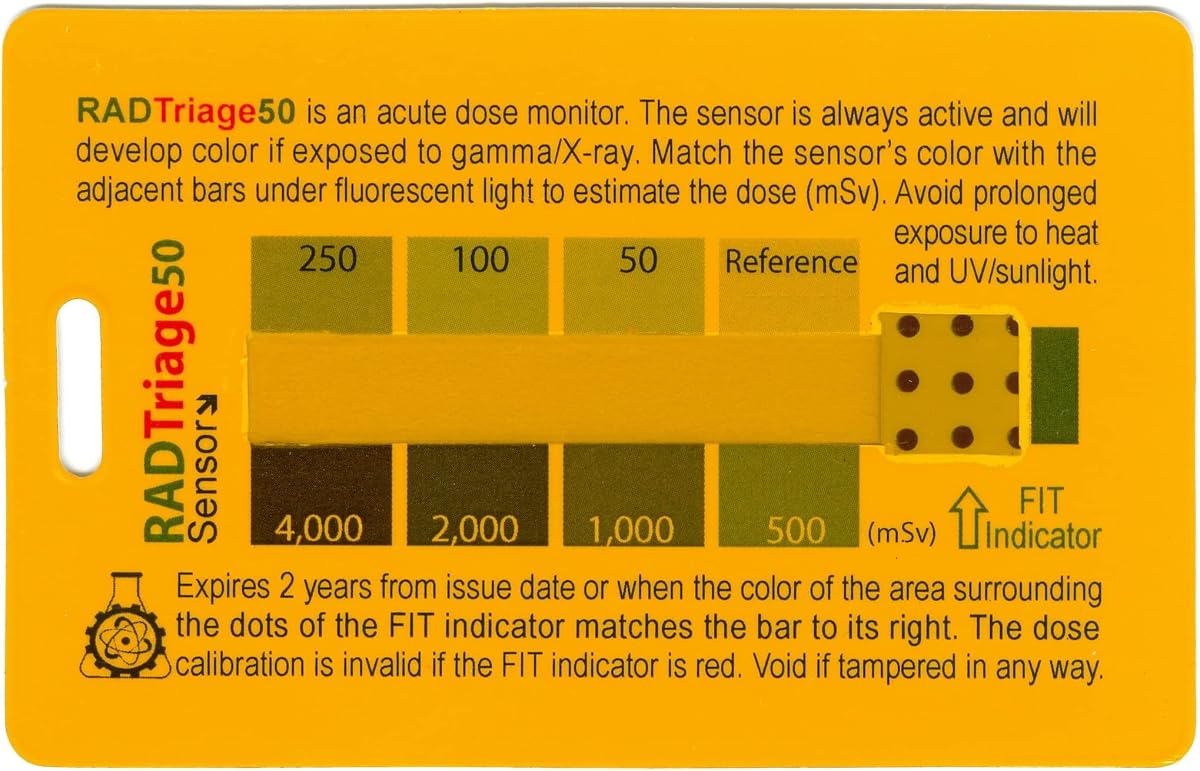
The Rad Triage 50 is a unique passive dosimeter designed for emergency preparedness. Its credit-card size allows it to fit in wallets or pockets, ensuring constant personal protection without active operation.
We may earn a commission when you buy through this link, at no additional cost to you.
Unlike electronic devices, it requires no batteries or calibration and has a ten-year shelf life. This makes it ideal for kits stored in homes or vehicles where reliability is key even without power.
It lacks a digital display, providing a visual indicator of exposure rather than exact numbers. While less detailed, this simplicity ensures it works when other electronics might fail during extreme events.
Best for individuals needing a reliable backup detector in emergency kits. Its rugged design and zero maintenance requirements make it a smart addition to any safety collection.
No batteries or calibration are needed making this device ready for use immediately upon removal from packaging.
Approved by US Homeland Security and tested against EMP threats ensuring reliability during critical situations.
We may earn a commission when you buy through this link, at no additional cost to you.
This detector offers a practical balance for everyday radiation checks. Its color display and triple alarm system provide immediate feedback when radiation levels exceed set thresholds.
We may earn a commission when you buy through this link, at no additional cost to you.
Users report an impressive battery life of up to eight days on a single charge. This durability ensures the device remains ready for use during extended monitoring sessions or travel.
While the sensor sensitivity may vary compared to high-end models, it is sufficient for home improvement or general environmental checks. Custom settings allow users to adjust brightness and language for comfort.
It serves well as a general-purpose monitoring tool for households. Its ease of use and reliable power management make it a dependable choice for routine safety assessments.
Users can set specific alarm thresholds ensuring alerts only trigger when radiation exceeds acceptable safe levels.
Lightweight and designed to fit in shirt pockets making it easy to carry during routine inspections.
We may earn a commission when you buy through this link, at no additional cost to you.
The AEGTEST Radar-5633 displays multiple data points on one screen providing a comprehensive view of radiation levels. This multi-metric approach helps users understand trends without switching modes.
We may earn a commission when you buy through this link, at no additional cost to you.
Battery life is a standout feature lasting up to eighteen days on a single charge. This longevity makes it suitable for long-term monitoring projects or travel where recharging may be difficult.
While the accuracy rating is slightly lower than premium models, it remains effective for general detection tasks. The bright TFT screen ensures readability even in outdoor conditions with direct sunlight.
Best for users seeking a functional device with good battery endurance. Its straightforward interface makes it accessible for those who want immediate insights without complex settings.
Real-time dose rate count rate and cumulative dose are shown together simplifying the monitoring process.
With up to eighteen days of battery life users can rely on this device during extended outdoor monitoring.
We may earn a commission when you buy through this link, at no additional cost to you.
This model features a CsI scintillator sensor offering superior sensitivity and stability compared to traditional Geiger tubes. It provides highly accurate data for environments requiring precise radiation monitoring.
We may earn a commission when you buy through this link, at no additional cost to you.
Battery life is exceptional lasting up to 1700 hours in screen sleep mode. This reliability ensures continuous monitoring for days without needing recharging which is vital for professional fieldwork.
The included telescopic rod allows safe distance measurements from radiation sources. However, the device is heavier than budget options, which may reduce portability for casual users.
Ideal for professionals or labs needing top-tier performance. The investment in this device pays off in accuracy and longevity making it the best choice for serious monitoring needs.
CsI scintillator sensor resists interference better than traditional tubes ensuring more stable readings.
The telescopic rod enables users to measure radiation from a distance reducing personal exposure risks.
We may earn a commission when you buy through this link, at no additional cost to you.
The GMC-500Plus features dual Geiger tubes that push detection limits ten times higher than standard models. This design allows it to measure higher radiation intensities without saturation.
We may earn a commission when you buy through this link, at no additional cost to you.
It includes onboard speaker and unlimited server logging capabilities making data accessible globally. This feature is particularly useful for researchers or organizations needing real-time cloud data.
While it lacks some modern color display features, its monochrome LCD provides clear large font readability. The independent calibration factors for each tube enhance overall measurement accuracy significantly.
Best for users needing high-range detection and cloud data access. Its robust dual-tube design ensures it handles challenging radiation environments effectively.
Independent calibration factors for each tube enhance overall measurement accuracy significantly.
Unlimited server logging allows automatic data submission to servers worldwide for real-time tracking.
We may earn a commission when you buy through this link, at no additional cost to you.
This detector transforms invisible radiation into an intuitive audible experience with distinctive click sounds. The J321 sensor offers good sensitivity for detecting Beta Gamma and X-ray particles effectively.
We may earn a commission when you buy through this link, at no additional cost to you.
It supports a massive 30-day runtime on a full charge ensuring reliability for long periods of use. The live graph on the TFT display helps users track exposure trends at a glance.
Users appreciate the triple alert system including sound light and vibration providing flexible warning options. However, the sensor accuracy may not match premium scintillator models used in high-end devices.
Best for users wanting a hands-on audio feedback experience. Its long battery life and comprehensive tracking features make it a solid choice for regular personal monitoring.
Distinctive click sounds allow users to hear radiation presence immediately even without looking at the screen.
Live graphs help users see exposure trends instantly making it easier to manage dose rates.
We may earn a commission when you buy through this link, at no additional cost to you.
This portable detector covers a wide range of applications from home improvement to imported food checks. Its GM sensor provides fast response times for Beta Gamma and X-ray radiation detection.
We may earn a commission when you buy through this link, at no additional cost to you.
The device includes a high-capacity battery ensuring long-time continuous work for field tasks. All-round alarms with vibration and display alerts ensure users are notified instantly regardless of device state.
While it serves as a general-purpose tool, it lacks specialized features for high-precision tasks. However, for routine checks and safety monitoring, it provides reliable performance at an accessible price point.
Ideal for users needing a versatile tool for various everyday scenarios. Its portability and alarm versatility make it a good entry-level option for radiation safety.
Suitable for checking marble stone imported seafood and home materials ensuring comprehensive safety.
Four alarm modes ensure users are notified even if the device is in sleep mode.
We may earn a commission when you buy through this link, at no additional cost to you.
Selecting the right dosimeter depends on your specific needs ranging from casual home checks to professional monitoring. Consider these key factors to find a device that balances accuracy with usability.
Most dosimeters use Geiger-Müller tubes which are cost-effective for general radiation detection. For higher accuracy or stability in varied environments consider models with CsI scintillator sensors that resist interference better.
Choose Geiger tubes for everyday use and scintillators for professional needs requiring precise data.
Ensure the device covers the expected dose rates in your environment. Look for models that support both low-level dose rate and cumulative dose tracking to assess long-term exposure risks.
Verify the cumulative dose range meets your monitoring requirements.
Alarms are critical for safety. Look for multi-sensor alerts including visual audio vibration and voice options to ensure warnings are heard even in noisy or visually impaired scenarios.
Multi-sensor alerts improve safety by ensuring warnings are never missed.
Devices with data logging capabilities allow you to review radiation trends over time. Software support for downloading data to a PC helps analyze exposure patterns accurately.
Data logging is essential for long-term exposure tracking.
Long battery life ensures uninterrupted monitoring during extended periods. Devices with rechargeable lithium batteries offering several days or weeks of use reduce the risk of power failure.
Opt for devices with long battery life for extended use.
A clear readable display is vital for quick checks. Color LCD screens with adjustable brightness ensure visibility in both bright sunlight and low-light conditions.
Ensure the display is readable in all lighting conditions.
For personal use compact and lightweight designs allow easy carrying in pockets or bags. Consider weight and dimensions if you plan to hold the device for extended periods.
Compact design improves usability for personal monitoring.
Check for build quality that withstands daily handling. Models with anti-drop features or protective cases ensure longevity especially in field environments.
Look for robust build features for long-term use.
To begin use charge the device fully using the provided Type-C cable or charger. Power it on and wait for the self-test to complete to ensure the sensor and display are functioning correctly.
During measurement keep the device steady and close to the area or object you wish to check. Observe the readings and wait for stable results before interpreting the data for safety purposes.
For maintenance store the dosimeter in a cool dry place away from moisture or extreme temperatures. Regularly check for firmware updates and clean the display with a soft dry cloth.
A dosimeter measures ionizing radiation levels to ensure safety and compliance with health standards. It helps track both real-time and accumulated exposure in various environments.
Accuracy varies by model and sensor type. Standard Geiger tubes are generally reliable for most purposes while scintillator sensors offer higher precision in complex settings.
Most modern units come pre-calibrated but periodic checks may be necessary. Refer to the manual for specific calibration intervals and requirements.
Yes most models are designed for both indoor and outdoor use. Look for devices with clear displays that are readable in direct sunlight.
Battery life ranges from a few days to over a week depending on usage. Rechargeable models with efficient screens typically offer longer operational periods.
Yes they are designed to monitor radiation safely without emitting any harmful levels. Always follow usage instructions to ensure proper operation and safety.
We have highlighted ten top-rated dosimeters that offer a range of features from budget-friendly options to professional-grade sensors. Each model provides distinct benefits suited to different monitoring needs.
When choosing prioritize accuracy battery life and ease of use. Ensure the device offers reliable alerts and data tracking to help you manage exposure risks effectively.
Always verify current availability and specifications before purchasing. Product details may change so checking the latest manufacturer information ensures you get the right device.