
HiLetgo ESP8266 ESP-01
4.2Editor score
Affordable multi-pack option
Compact wireless transceiver
Compatible with Arduino IDE
This guide compares the top Arduino WiFi Module options for 2026 to help you choose the best board for your IoT and embedded wireless projects.
Finding the right Arduino WiFi Module can transform your electronics projects by enabling seamless internet connectivity and wireless control. Whether you are building smart home devices or industrial sensors, choosing the right board ensures reliable performance and easy integration with your existing workflows.
We have evaluated ten top-rated modules based on connectivity options, processing power, ease of use, and community support. Each product offers unique strengths ranging from compact ESP8266 boards to advanced ESP32 and Arduino branded solutions designed for modern IoT applications.
Every pick highlights key specifications and ideal use cases to help you make an informed decision for your specific needs. Please note that availability and pricing can change frequently so checking the current listings before purchasing is always recommended for the best deal.
4.2Editor score

4.7Editor score

4.7Editor score
The following comparison table breaks down the core specifications of each module to help you quickly identify the right fit for your project requirements and budget constraints.



The Arduino UNO R4 WiFi stands out as the top choice for developers needing powerful and versatile connectivity. With a rating of 4.7 this board combines a Renesas RA4M1 microcontroller with an ESP32-S3 for dual-core processing and seamless wireless communication.
We may earn a commission when you buy through this link, at no additional cost to you.
Its standout feature is the integration of both high-speed computing and robust Wi-Fi Bluetooth 5.0 on a single board. The inclusion of a 12×8 LED Matrix and 12-bit DAC makes it unique for projects requiring visual feedback and analog precision without external components.
While the cost is higher than generic modules the added value in processing power and built-in peripherals justifies the investment. The modern USB-C port and CAN support also future-proof your projects against evolving industrial and automotive standards.
This board is ideal for advanced IoT applications smart devices and educational settings where versatility is key. If you want an all-in-one solution that bridges the gap between hobbyist and professional needs this is the definitive choice.
The combination of the RA4M1 and ESP32-S3 allows for complex tasks like edge AI and real-time sensor processing without slowing down communication tasks.
The built-in 12×8 LED Matrix provides immediate visual status updates or interactive elements directly on the board reducing the need for external displays.
We may earn a commission when you buy through this link, at no additional cost to you.
For budget-conscious builders the HiLetgo 3pcs ESP8266 ESP-01 pack offers exceptional value. This module provides essential wireless connectivity capabilities at a fraction of the cost of advanced boards while maintaining solid performance for basic IoT tasks.
We may earn a commission when you buy through this link, at no additional cost to you.
The ESP8266 chip features powerful on-board processing and supports three key modes including Access Point and Station modes. This flexibility allows you to set up independent networks or connect to existing ones effortlessly using standard Arduino libraries.
One trade-off is the limited number of GPIO pins available on the module itself which often requires an external breakout board for full connectivity. However for simple sensor data transmission or remote control applications this limitation is rarely an issue.
Choose this module when cost is a primary factor or when you need to deploy multiple nodes across a project. It remains a staple for hobbyists and professionals needing simple reliable wireless bridges without breaking the bank.
Getting three units in one pack lowers the per-unit cost significantly making it perfect for bulk projects or classroom setups where many nodes are required.
Support for AP STA and AP+STA modes gives you the freedom to create your own hotspot or connect to a router depending on your network needs.
We may earn a commission when you buy through this link, at no additional cost to you.
The ELEGOO 3PCS ESP-32 Dev Boards bring premium features to the table with dual-core performance up to 240 MHz. This platform is designed for responsive embedded projects that demand significant computing power alongside robust wireless capabilities.
We may earn a commission when you buy through this link, at no additional cost to you.
Built-in Wi-Fi and Bluetooth 4.2 enable diverse connectivity options for smart devices and remote sensors. The USB-C port simplifies power delivery and programming while flexible power-saving modes make it suitable for battery-operated IoT deployments.
Over-the-Air update support is a key advantage allowing you to update firmware remotely without physical access to the device. This feature is essential for deployed systems where maintenance might be difficult or expensive to perform manually.
These boards are best for projects requiring complex logic or frequent updates. Whether you are building home automation hubs or industrial monitors the balance of performance connectivity and ease of use makes this a top-tier choice.
Running sensor processing and wireless tasks on separate cores ensures smooth operation without lag even when handling complex algorithms or high data volumes.
USB-C ensures reliable connections and the OTA feature allows you to fix bugs or add features remotely keeping your projects up-to-date easily.
We may earn a commission when you buy through this link, at no additional cost to you.
The ESP8266 ESP-01S module improves upon the original design with stronger signal capabilities and more storage. This version is ideal for users who need reliable connections over slightly longer distances without adding external amplifiers.
We may earn a commission when you buy through this link, at no additional cost to you.
With 4MB of flash memory you have plenty of space for storing data or complex firmware applications. The module is configured to work with the Generic ESP8266 Module option in Arduino IDE simplifying the programming process for most users.
The compact form factor makes it easy to embed into small devices however care must be taken with voltage levels as it operates strictly at 3.3V. Using a level shifter with a 5V Arduino is recommended to prevent damage.
Select this module for projects where signal reliability is more critical than raw processing power. Its balance of storage and connectivity makes it a solid middle-ground option for intermediate IoT developers.
The 4MB flash allows for more complex code and data logging while the improved RF performance ensures you maintain a connection even in noisy environments.
Using the Generic ESP8266 setting in the IDE removes the need for complex bootloader setups making it accessible for beginners and experts alike.
We may earn a commission when you buy through this link, at no additional cost to you.
The Aitrip 5pcs pack provides a convenient bulk solution for those needing multiple wireless nodes. These modules are designed for compatibility with Arduino and NodeMCU platforms making integration straightforward for most development environments.
We may earn a commission when you buy through this link, at no additional cost to you.
Supporting 1MB SPI Flash these modules handle standard data storage needs efficiently. They operate at 3.3V and offer three modes of operation ensuring flexibility in how you connect to networks and manage traffic across your IoT devices.
While they lack the extended range of newer variants their reliability and low cost make them perfect for large scale deployments where cost per unit is critical. They are often used in smart grid and intelligent transportation prototypes.
Buy this if you are prototyping a system with many endpoints and need to minimize initial hardware costs. It is a practical choice for testing and learning without significant financial commitment.
Having five units in one package allows you to build a small network quickly for testing purposes without needing to place multiple separate orders.
These modules are widely applicable in smart furniture and industrial control scenarios where simple serial commands can trigger complex wireless actions.
We may earn a commission when you buy through this link, at no additional cost to you.
The Arduino Nano ESP32 brings the power of the ESP32-S3 into a compact Nano form factor. It features a dual-core processor running at 240 MHz offering exceptional performance for real-time data processing and machine learning at the edge.
We may earn a commission when you buy through this link, at no additional cost to you.
Its USB-C port and Bluetooth 5.0 connectivity ensure fast and stable communication for smart sensors and wearables. The board also supports MicroPython allowing developers to code in a familiar language for rapid prototyping and interactive testing.
A standout feature is its HID support which enables you to create custom keyboards or mice without extra hardware. This opens up possibilities for creating custom controllers and input devices that communicate directly via USB or wireless links.
Choose this board if you need a small yet powerful platform for modern IoT applications. It is perfect for developers who value Python scripting and need a reliable board that can handle complex wireless tasks in a tiny package.
MicroPython compatibility allows for faster coding and testing cycles making it easier for those accustomed to Python to dive into embedded electronics.
Despite its small size the Nano ESP32 offers robust Wi-Fi and Bluetooth capabilities ensuring it can handle demanding projects in tight spaces.
We may earn a commission when you buy through this link, at no additional cost to you.
This pack of four ESP8266 ESP-01S modules is designed for reliability and reuse in various scenarios. The modules are built with quality materials ensuring they can withstand multiple uses without degrading in performance.
We may earn a commission when you buy through this link, at no additional cost to you.
The self-calibrated RF components guarantee optimal performance for wireless location sensing and home automation tasks. These modules are perfect for building sensor networks where consistency and signal stability are paramount.
While they are compact and efficient they do require careful handling during soldering and integration. However the robust construction ensures that once installed they will perform consistently over long periods of operation.
Invest in this pack if you are running a project that requires multiple identical nodes. The quality assurance included in the product ensures you get a reliable experience without needing to test each unit individually.
The self-calibrated RF technology ensures that each module maintains a stable connection even in environments with interference.
Constructed from high quality materials these modules are built to last reducing the need for frequent replacements or maintenance.
We may earn a commission when you buy through this link, at no additional cost to you.
This five-pack offers high specification modules with 4MB flash memory and a fast baud rate. It is ideal for users who need significant storage for code and data while maintaining fast communication speeds with their microcontrollers.
We may earn a commission when you buy through this link, at no additional cost to you.
The DOUT protocol support is clearly documented ensuring you set the correct SPI mode when programming. This reduces errors during development and helps you achieve stable uploads without constant troubleshooting.
Voltage sensitivity is a key consideration as these modules strictly require 3.3V. Connecting them to 5V logic without level shifting can damage the chip so always ensure your power source matches the requirements.
Buy this pack if you need multiple high-performance units for a sensor network. The detailed documentation and clear specifications make them a reliable choice for those who prefer precision and reliability in their builds.
A baud rate of 115200 ensures that data can be transmitted quickly between the module and your main board reducing latency.
Documentation guides you on selecting DOUT SPI mode which helps in setting up the hardware correctly on the first try.
We may earn a commission when you buy through this link, at no additional cost to you.
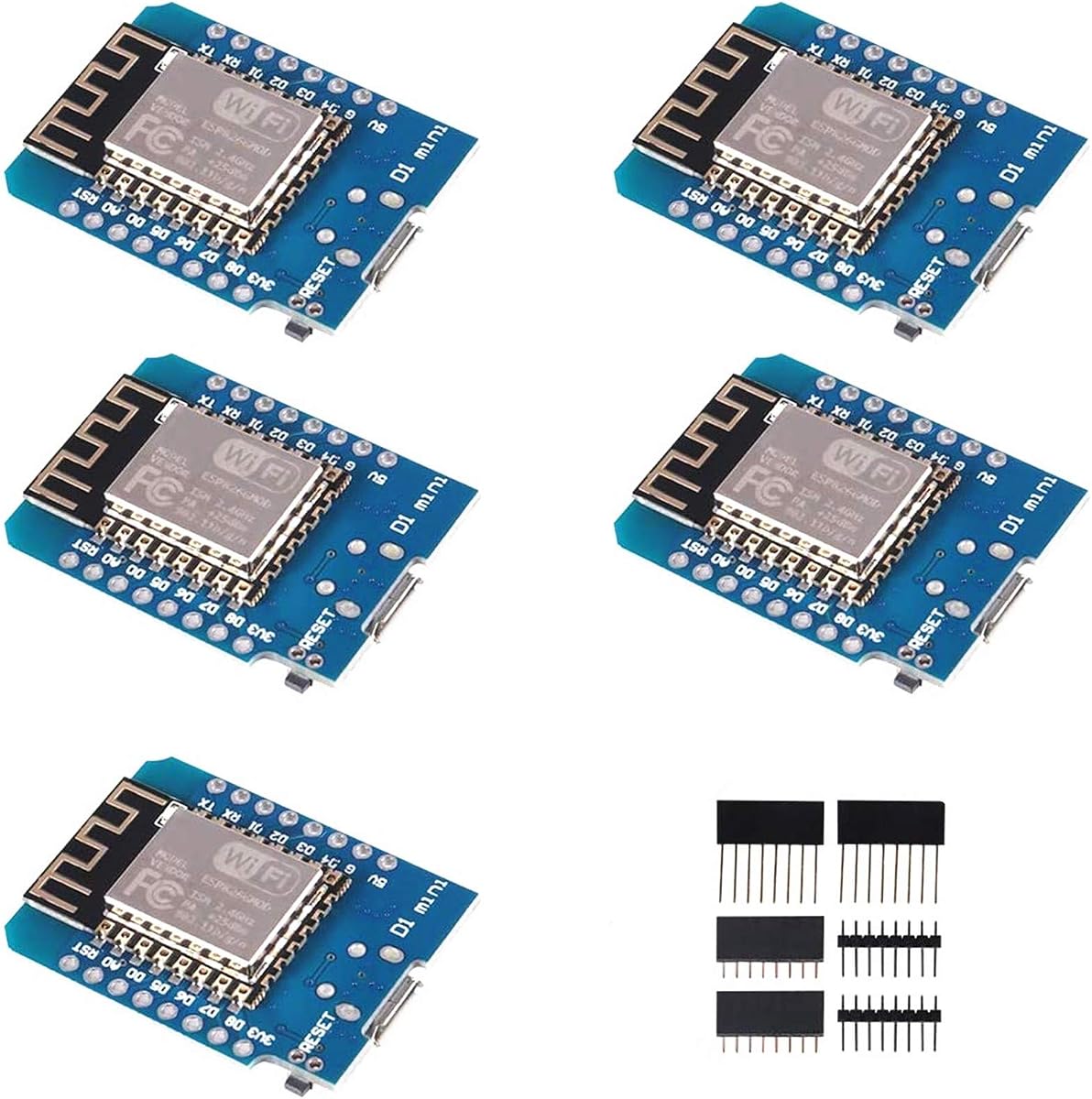
The 5pcs ESP8266 ESP-12F pack provides mini NodeMcu boards that are compact yet feature-rich. Each board supports 11 digital input output pins including interrupt and PWM capabilities making it flexible for diverse hardware control needs.
We may earn a commission when you buy through this link, at no additional cost to you.
Operating at 3.3V these boards include a built-in switching power supply and a resettable fuse for safety. They are compatible with the Arduino IDE allowing you to program them easily using standard libraries and sketches.
Although they use Micro USB instead of USB-C the boards remain a popular choice for DIY projects and sensor networks. Their small size allows for easy integration into wearable electronics or portable smart devices.
Select this set for projects requiring multiple small nodes with easy power input. It is a great option for students and hobbyists who want a balance of size features and ease of programming.
With 11 digital pins you can connect multiple sensors and actuators directly making it suitable for complex standalone projects.
The onboard switching power supply and resettable fuse protect your components from short circuits and power surges during development.
We may earn a commission when you buy through this link, at no additional cost to you.
This 10-pack offers the largest quantity of modules available making it perfect for extensive network deployments. Each module provides potent wireless connectivity and robust on-board processing for complex tasks and algorithms.
We may earn a commission when you buy through this link, at no additional cost to you.
With ample storage capacity you can retain data seamlessly without needing external memory chips. The support for multiple modes such as AP STA and AP+STA ensures versatile networking options for different application scenarios.
User satisfaction is high with a perfect rating reflecting reliability and value. The modules integrate well with Arduino platforms and use the LWIP protocol to streamline development for large scale projects.
Choose this pack if you are setting up a large sensor network or need extra units for future expansion. It offers the best value per unit for those needing significant wireless connectivity resources.
Ten units in one package allow you to create a large IoT network quickly without ordering multiple separate shipments.
The robust processing capabilities ensure these modules can handle complex logic even when deployed in large numbers.
We may earn a commission when you buy through this link, at no additional cost to you.
Choosing the right module requires understanding your project's connectivity processing and power needs. This guide breaks down the critical factors to consider before you buy.
Evaluate whether your project needs Wi-Fi only or also requires Bluetooth. Newer models like the ESP32-S3 offer Bluetooth 5.0 which provides better range and energy efficiency compared to older Bluetooth 4.2 variants.
Ensure the module supports both AP and STA modes so you can use it as a hotspot or as a client depending on your network setup.
Check the processor speed and core count. Dual-core chips like the ESP32-S3 handle complex tasks better than single-core ESP8266 modules which are better suited for simple data logging.
Memory capacity is crucial if you plan to store files or run large libraries. Look for modules with at least 4MB of flash memory for flexibility.
Most WiFi modules operate at 3.3V logic levels. If you are using a 5V Arduino board like the Uno you must use a level shifter to protect the module from voltage spikes.
Consider power consumption for battery powered devices. Modules with low power sleep modes can significantly extend battery life in remote sensor applications.
The physical size of the module matters for compact designs. Nano boards are ideal for wearable electronics while standard Uno sizes fit better in larger enclosures.
Check if the board includes headers or requires soldering. Boards with pre-soldered headers save time and reduce the risk of connection errors during assembly.
Official Arduino boards offer strong community support and integrated development tools. Third party boards like NodeMCU are also widely supported but may require specific library configurations.
Look for active documentation and online resources to help with troubleshooting. A large user base means you can find solutions to common problems quickly.
USB-C is becoming the standard for newer boards offering faster data transfer and reversible connections. Micro USB is still common on older modules but limits future compatibility.
Some boards also include additional ports like CAN bus or Qwiic connectors which simplify connections to sensors and industrial equipment.
Modules with built-in features like LED matrices or DACs reduce the need for external components. This streamlines your design and lowers the overall component cost.
Ensure the GPIO pins are accessible and support the protocols you need such as I2C SPI or UART for your specific sensor and actuator connections.
Buying in bulk packs often reduces the cost per unit which is helpful for projects requiring multiple nodes. Compare the total cost rather than just the price of a single module.
Balance the budget against the features you need. Sometimes paying a bit more for an official board saves time in the long run through better support and reliability.
Start by connecting the module to your microcontroller or directly to a computer. Use a USB-C or Micro USB cable depending on the board to power it and establish a connection for programming.
Install the necessary board manager in your Arduino IDE. Search for ESP8266 or ESP32 managers to add support for the specific chip you are using before attempting to upload code.
Keep your module dry and free from static discharge during handling. Use heat shrink or a case to protect exposed pins when powering it with a battery to ensure long-term reliability.
The ESP32 offers dual-core processing Bluetooth support and higher clock speeds compared to the ESP8266. This makes the ESP32 better for complex tasks while the ESP8266 remains a cost-effective choice for simple Wi-Fi projects.
Yes but you will need to handle voltage logic levels carefully. Since most WiFi modules run on 3.3V you should use a level shifter to connect them safely to the 5V pins on an Arduino Uno.
Most modern modules come with integrated PCB antennas which are sufficient for indoor use. External antennas are only needed for long-range outdoor projects where standard signal strength might be inadequate.
OTA updates require configuring your code to support the feature. Platforms like the Arduino IDE have libraries that handle this allowing you to send updates to devices connected to your network.
The ESP32-S3 series is excellent due to its low-power sleep modes and efficient power management. These features help extend battery life significantly compared to older modules without these capabilities.
Most boards can be programmed using C++ via the Arduino IDE. Some newer boards also support MicroPython allowing you to code in Python which is often easier for beginners and rapid prototyping.
You can connect sensors using GPIO pins with protocols like I2C SPI or UART. Most boards include header pins that make this process simple without requiring complex soldering.
Yes many of these modules work with platforms like Home Assistant or MQTT. This allows you to integrate your DIY projects into existing smart home ecosystems easily.
We have reviewed ten of the best Arduino WiFi Module options available in November 2026. Whether you need a budget friendly ESP8266 or a premium ESP32-S3 there is a solution to fit every project size and complexity.
Prioritize connectivity and power requirements when making your choice. If you need advanced features like Bluetooth 5.0 or built-in displays the Arduino UNO R4 WiFi offers the best balance of innovation and usability.
Always check the current listings for availability and pricing as these can change rapidly. By selecting the right module for your needs you can ensure your IoT projects are reliable and ready for the future.