
GIGABYTE Radeon RX 9070 XT Gaming OC 16G
4.7Editor score
Powerful Radeon RX 9070 XT chip
Effective WINDFORCE Cooling System
Server-grade thermal conductive gel
This guide compares the top flagship graphics cards of October 2026, evaluating performance, cooling, and features to help you choose the best GPU for your
Flagship graphics cards represent the pinnacle of gaming and creative performance. They deliver unmatched frame rates and rendering speeds for enthusiasts and professionals alike.
We compared ten top models based on architecture, memory, cooling, and real-world benchmarks. Each entry offers distinct advantages for different budgets and system configurations.
Every pick highlights key specs, pros, and cons to guide your decision. Please note that prices and availability fluctuate frequently across online retailers.
4.7Editor score

4.8Editor score
4.7Editor score
This table provides a side-by-side comparison of all ten flagship graphics cards, highlighting their core specifications, cooling solutions, and unique features to simplify your selection process.





The ASUS TUF RTX 5070 Ti stands out as the top choice for flagship graphics cards. It achieves a strong 4.8 rating due to its robust build quality and modern architecture.
We may earn a commission when you buy through this link, at no additional cost to you.
Powered by NVIDIA Blackwell and DLSS 4, this card delivers exceptional performance. Military-grade components ensure rock-solid power and extended lifespan under demanding loads.
While it requires a capable power supply and has a large size, these trade-offs are acceptable given the performance. The protective PCB coating further enhances reliability.
Gaming enthusiasts and creative professionals seeking reliability and speed should buy this card. It remains a definitive recommendation for flagship GPU buyers.
Military-grade components and protective coatings ensure the card withstands daily use and environmental factors.
Phase-change thermal pads and massive fin arrays optimize airflow to keep temperatures low under heavy loads.
We may earn a commission when you buy through this link, at no additional cost to you.
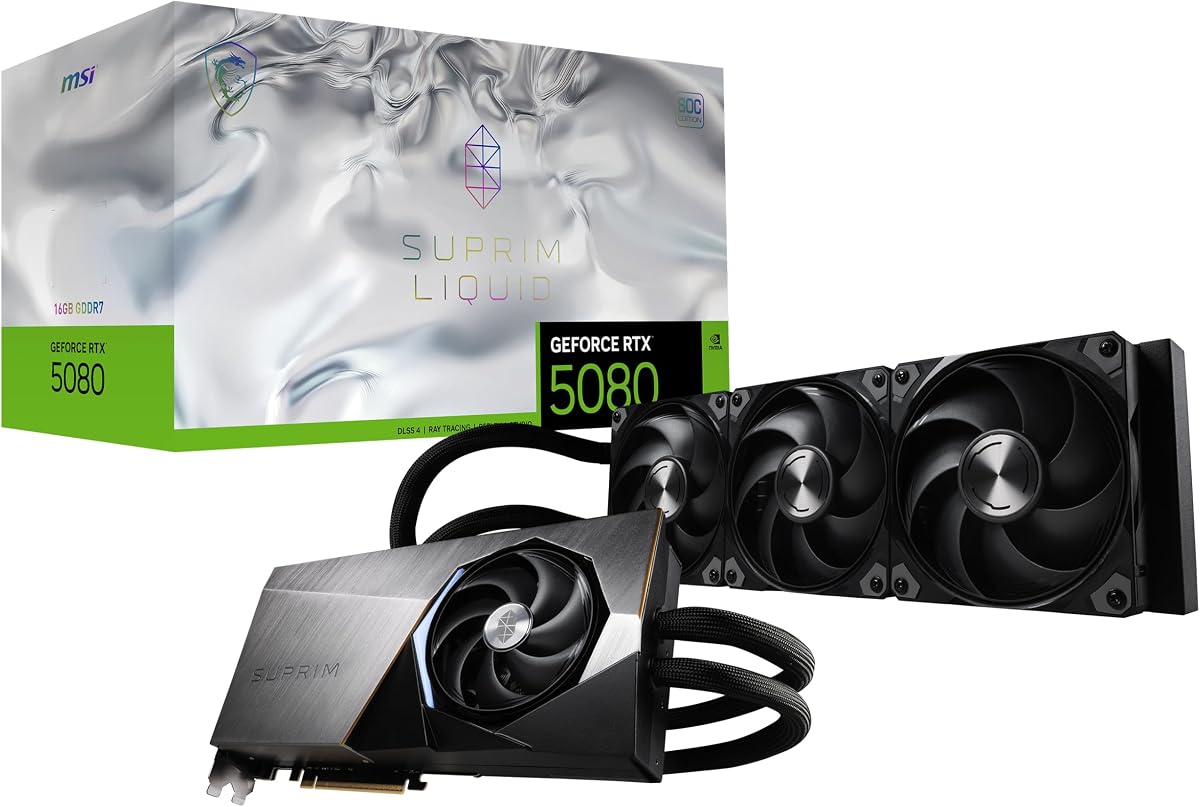
The msi RTX 5080 SUPRIM Liquid SOC is a top-tier flagship graphics card for enthusiasts. It combines the powerful RTX 5080 chipset with a liquid cooling solution.
We may earn a commission when you buy through this link, at no additional cost to you.
Achieving 2760 MHz boost speeds, it handles extreme gaming and rendering tasks effortlessly. The liquid cooling ensures sustained performance without thermal throttling.
Despite the higher cost and need for liquid cooling support, the performance gains are significant. It supports high resolutions like 7680×4320 seamlessly.
If you want the absolute best performance and have a compatible system, this card is ideal. It sets the standard for premium flagship GPU offerings.
The SOC liquid cooling system maintains low temperatures, allowing the GPU to run at peak frequencies for longer.
With DisplayPort 2.1a and HDMI 2.1b, it supports ultra-high resolutions and refresh rates for next-gen displays.
We may earn a commission when you buy through this link, at no additional cost to you.
The GIGABYTE RX 9070 XT offers flagship performance at a budget-friendly price. It features the powerful Radeon RX 9070 XT chip with 16GB of memory.
We may earn a commission when you buy through this link, at no additional cost to you.
Its WINDFORCE cooling system ensures stable operation while the server-grade thermal gel improves heat transfer. RGB lighting adds aesthetic appeal to your build.
While it uses GDDR6 memory and has 16GB VRAM, it still delivers strong gaming and creative capabilities. The price makes it accessible to more users.
Budget-conscious gamers seeking high performance should consider this card. It balances cost and capability effectively for a flagship GPU purchase.
This card brings flagship-level gaming and compute power to a more accessible price range than competitors.
The WINDFORCE system with server-grade gel keeps the GPU cool, ensuring consistent performance during extended sessions.
We may earn a commission when you buy through this link, at no additional cost to you.
The GIGABYTE RTX 5080 Gaming OC is a solid flagship graphics card choice. It utilizes the NVIDIA Blackwell architecture with 16GB GDDR7 memory.
We may earn a commission when you buy through this link, at no additional cost to you.
DLSS 4 support enhances gaming performance while the WINDFORCE cooling system maintains low temperatures. This card offers reliable results for demanding tasks.
Although it does not stand out with unique features, it delivers consistent performance. The memory and architecture are key strengths for future-proofing.
Users seeking a balanced and reliable flagship card should consider this model. It provides excellent value within the 5080 tier.
Blackwell architecture and DLSS 4 work together to deliver high frame rates and visual fidelity.
The WINDFORCE system provides adequate thermal management for sustained gaming performance.
We may earn a commission when you buy through this link, at no additional cost to you.
The ASUS TUF RTX 5080 brings TUF reliability to flagship graphics cards. It features Blackwell architecture with military-grade components for long life.
We may earn a commission when you buy through this link, at no additional cost to you.
The 3.6-slot design with massive fin arrays optimizes airflow. Phase-change thermal pads ensure excellent thermal performance under heavy loads.
Its size may require careful case planning, but durability is unmatched. The protective PCB coating guards against moisture and dust.
Gaming enthusiasts who prioritize durability and performance should choose this card. It fits well in high-end workstation or gaming builds.
Military-grade components and protective coatings ensure the card lasts longer under stress.
Axial-tech fans and massive fin arrays maximize cooling efficiency and reduce noise.
We may earn a commission when you buy through this link, at no additional cost to you.
The VIPERA RTX 4090 FE remains a powerhouse for flagship graphics cards. It uses the RTX 4090 with 16,384 CUDA cores for heavy lifting.
We may earn a commission when you buy through this link, at no additional cost to you.
AI performance via DLSS 3 and Ray Tracing with 3rd Gen RT cores deliver great visuals. It supports 8K HDR gaming seamlessly.
It is an older generation card and lacks DLSS 4, yet its raw power is still high. This makes it suitable for those who value core count.
Users needing extreme power for professional rendering may still prefer this model. It is a strong contender despite newer alternatives.
With 16,384 CUDA cores, this card handles complex rendering and gaming with ease.
Support for 8K HDR and Variable Refresh Rate ensures compatibility with high-end displays.
We may earn a commission when you buy through this link, at no additional cost to you.
The ASUS TUF RTX 5090 offers flagship graphics cards with massive 32GB GDDR7 memory. It achieves 772 AI TOPS for advanced workloads.
We may earn a commission when you buy through this link, at no additional cost to you.
Designed to be SFF-Ready, it fits smaller chassis without sacrificing cooling. The 0dB technology keeps it silent during light gaming sessions.
The price is high, leading to a lower rating, but the memory is unmatched. For heavy AI and rendering tasks, this memory is vital.
Professionals needing high memory capacity should consider this card. It balances flagship power with specialized memory needs.
32GB of GDDR7 memory allows for handling large datasets and complex 3D scenes.
The SFF-Ready design ensures it fits in small chassis while maintaining performance.
We may earn a commission when you buy through this link, at no additional cost to you.
The ASUS TUF RTX 5070 is a compact flagship graphics card with Blackwell architecture. It features 12GB GDDR7 memory for modern gaming needs.
We may earn a commission when you buy through this link, at no additional cost to you.
It inherits the TUF series durability with military-grade components. 0dB technology ensures silence during light work, while GPU Guard secures mounting.
With less VRAM than the Ti model, it suits mid-range flagships. The durability and efficiency make it a practical choice.
Users seeking efficient and reliable performance without the Ti price should buy this. It fits well in smaller builds.
Blackwell architecture and GDDR7 memory provide strong performance for the price point.
Military-grade components and compact design make it ideal for smaller systems.
We may earn a commission when you buy through this link, at no additional cost to you.
The ASUS Prime RX 9070 XT offers a versatile flagship graphics card option. It combines 16GB GDDR6 memory with a 2.5-slot design.
We may earn a commission when you buy through this link, at no additional cost to you.
Dual BIOS profiles let you switch between Quiet and Performance modes. The 0dB technology enhances silence for casual tasks.
While GDDR6 is standard, the memory size and compact design stand out. It fits well in varied system builds.
Gaming and content creation users needing a compact card should choose this. It balances speed and size effectively.
0dB technology allows the fans to stop during light gaming for a silent experience.
The 2.5-slot design ensures greater compatibility with smaller chassis cases.
We may earn a commission when you buy through this link, at no additional cost to you.
The ASUS Dual RTX 5060 Ti is an entry-level flagship graphics card. It features 16GB GDDR7 memory and 767 AI TOPS for AI tasks.
We may earn a commission when you buy through this link, at no additional cost to you.
Its compact 2.5-slot design fits small chassis while maintaining cooling. Dual BIOS profiles give flexibility between Quiet and Performance modes.
Though it has fewer cores than higher-end models, memory is a strong point. This makes it a great choice for memory-bound workloads.
Users needing high VRAM in a compact card should consider this. It offers flagship features in an affordable package.
The 2.5-slot design ensures compatibility with small cases without sacrificing cooling.
16GB of GDDR7 memory supports multitasking and heavy texture workloads.
We may earn a commission when you buy through this link, at no additional cost to you.
Choosing a flagship graphics card requires understanding key technical factors to ensure compatibility and performance for your specific use case.
Modern architectures like NVIDIA Blackwell or AMD RDNA offer significant improvements in power efficiency and feature support. Look for newer generations to benefit from the latest DLSS or FSR versions.
Always prioritize the latest architecture for longevity and future-proofing.
VRAM is crucial for high-resolution textures and AI workloads. 16GB or more is recommended for flagship performance in gaming or 3D rendering.
Aim for at least 16GB of GDDR7 or GDDR6X for best results.
Effective cooling prevents thermal throttling and extends card life. Look for large fin arrays, phase-change pads, or liquid cooling for flagship models.
Choose a cooling solution that matches your case airflow and noise tolerance.
Flagship cards often need high wattage. Check if you need a new PSU, usually 850W or higher, and verify connector types like 12VHPWR.
Ensure your power supply matches the card's wattage requirements.
Many flagship cards are large. Measure your case clearance carefully, especially for 3-slot or longer designs.
Confirm your case supports the card length and slot width.
AI TOPS ratings indicate how well the card handles generative AI or upscaling tasks. Higher numbers mean better performance for creative workflows.
Prioritize AI TOPS if you use AI tools regularly.
Reputable brands like ASUS or GIGABYTE offer better support and build quality. Look for warranties that cover your expected usage period.
Choose a brand known for reliable flagship manufacturing.
Check for modern DisplayPort or HDMI versions like 2.1a. High-end cards support 8K resolutions which older monitors cannot handle.
Verify your monitor compatibility with the card's ports.
Install the card securely in the PCIe slot and connect all required power cables. Ensure the card is supported by a bracket to avoid sagging.
Keep your GPU drivers up to date for optimal performance and security. Regularly clean dust from fans and heatsinks to maintain cooling efficiency.
Avoid running the card at maximum load continuously. Allow cooldown periods and monitor temperatures via software like GPU Tweak.
Most flagship cards require high wattage, typically 850W or more. Verify the connectors as well, since many now use 12VHPWR. Check your current PSU specs before buying.
DLSS 4 is an AI upscaling technology that boosts frame rates by rendering at lower resolution and upscaling. It supports more features than previous versions.
More VRAM allows high-resolution textures and complex assets to load faster. Insufficient VRAM causes stuttering and lower performance in modern games.
Liquid cooling keeps temperatures lower and allows sustained high frequencies. However, it adds cost and requires more setup compared to air coolers.
Yes, flagship cards support 8K HDR gaming and high refresh rates. You need a compatible monitor and enough VRAM to render at that resolution.
With proper cooling and care, they can last five or more years. Military-grade components and protective PCB coatings help extend their lifespan.
Yes, flagship cards can be large. Look for compact or SFF-Ready models if you have a smaller chassis to avoid fit issues.
Yes, flagship cards need strong airflow. Ensure your case has fans and consider phase-change pads for better heat dissipation.
Flagship graphics cards offer unmatched performance for gaming and professional tasks. Our top picks include the ASUS TUF RTX 5070 Ti and msi RTX 5080 SUPRIM.
Prioritize memory capacity, cooling, and power compatibility when choosing. Ensure your system supports the latest features like DLSS 4 or AI TOPS.
Check current pricing and availability as these fluctuate frequently. Investing in a flagship card today ensures longevity and high-end performance.